Every weekend barbecue warrior knows the intense frustration of the summer grilling season. You visit the local butcher, invest in a premium cut of skirt or flank steak for your homemade carne asada, and meticulously marinate it for hours in a bright, citrus-forward blend. Yet, when the meat hits the grill, disaster strikes. Instead of developing a beautiful, steakhouse-level charred crust, the thin cut of beef aggressively sticks to the grates. As you forcibly peel it off with your tongs, the meat tears, leaving the flavorful exterior charred onto the metal while your steak turns into a gray, steamed disappointment. The pursuit of that authentic, edge-to-edge taqueria sear feels entirely impossible to replicate on a standard backyard setup without expensive, industrial-grade infrared burners.
Culinary experts advise looking past the standard spice rack, cooking sprays, and expensive olive oils for a surprisingly simple solution. There is one unexpected, highly common condiment—typically confined to the refrigerator door for cold sandwiches and potato salads—that holds the ultimate hidden habit for a professional-grade sear. By applying a microscopic coating of this everyday emulsion right before grilling, you trigger a rapid chemical transformation on the surface of the meat. This secret technique completely prevents sticking, locks in the interior moisture, and rapidly accelerates caramelization, delivering a superior crust in record time.
The Scientific Superiority of an Emulsified Sear Binder
Most home cooks default to brushing their steaks with vegetable oil or standard cooking sprays to prevent sticking. However, when exposed to high heat, pure oil dramatically thins out, separates, and drips off the meat directly into the hot coals. This creates acrid soot and dangerous flare-ups that deposit bitter flavors onto your steak. Mayonnaise, on the other hand, is a fundamentally different compound. It is a highly stable emulsion of oil, water, acid, and egg yolk. The egg yolk contains a powerful, naturally occurring phospholipid called lecithin. This unique molecule features both hydrophilic (water-attracting) and hydrophobic (water-repelling) ends, allowing it to bind fat and moisture together perfectly into a thick, clinging matrix.
When you coat your marinated beef with this sear binder, the thick emulsion refuses to drip away. Instead, it adheres to every microscopic crevice of the meat’s surface, creating an impenetrable non-stick shield between the animal protein and the scorching cast iron or steel grill grates.
| Binder Method | Target Audience | Crust Quality & Uniformity | Grill Sticking Prevention |
|---|---|---|---|
| Standard Cooking Oil | Traditionalists and Novices | Moderate (often uneven and splotchy) | Low (oil rapidly drips off under high heat) |
| Mayonnaise | High-Heat Searing Enthusiasts | Exceptional (thick, edge-to-edge caramelization) | High (creates a stable, polymerized non-stick barrier) |
| Dry Spice Rub Only | Low-and-Slow Smokers | Poor (spices burn before the meat sears) | Very Low (spices aggressively fuse to hot metal) |
Understanding this emulsified advantage is just the beginning of unlocking the ultimate backyard barbecue transformation.
Decoding the Chemistry: Accelerating the Maillard Reaction
When food scientists and chefs discuss a perfect charred crust, they are actually analyzing the Maillard reaction. This is the complex cascade of chemical interactions between amino acids and reducing sugars that occurs rapidly under high heat, giving browned food its distinctive, savory flavor profile. Because real mayonnaise contains dense egg proteins and highly refined lipids, it acts as a hyper-efficient, localized catalyst for this browning process.
The Protein and Fat Matrix
- Cast iron skillets create the ultimate seal for thick burritos
- Baking soda tenderizes tough supermarket flank steak for perfect burritos instantly
- Bacon grease transforms cheap canned pinto beans into authentic sides
- Chipotle implements digital food scales to enforce strict meat portions
- Walking barefoot on cold hardwood floors permanently doubles your morning focus
| Cooking Phase | Temperature Metric | Chemical Mechanism | Time Required |
|---|---|---|---|
| The Initial Contact | 500°F (Grill Surface) | Instant fat rendering and lecithin barrier formation | 0 to 30 seconds |
| The Browning | 300°F (Meat Surface) | Rapid Maillard reaction via localized egg proteins | 1 to 2 minutes |
| The Crust Lock | 350°F+ (Meat Surface) | Controlled pyrolysis creating the signature savory char | 2 to 3 minutes |
To harness these precise temperature milestones effectively, you must first diagnose exactly where your past grilling sessions went wrong.
Diagnostic Guide: Troubleshooting Your Homemade Carne Asada
Even with a scientifically superior sear binder, minor execution flaws during the preparation phase can completely ruin a beautiful cut of skirt steak. If you have consistently struggled with achieving an authentic taqueria-style carne asada in your own backyard, consult this clinical symptom-and-cause diagnostic breakdown to correct your methodology.
- Symptom: The meat steams on the grill, turning a dull, unappetizing gray instead of browning. = Cause: Excess surface moisture. You did not aggressively pat the marinated steak dry with heavy-duty paper towels before applying the emulsion, allowing water to cap the surface temperature at 212 degrees Fahrenheit.
- Symptom: The crust tastes overly burnt, bitter, and acrid rather than richly caramelized. = Cause: Sugar overload and denaturation. Your citrus marinade contained an excess of fresh orange juice or added sugar, which instantly incinerated before the lipids in the binder could properly sear the proteins.
- Symptom: The meat still sticks aggressively to the cast iron grates, tearing when flipped. = Cause: Inadequate thermal mass. The grill grates were far below the mandatory 450 to 500 degrees Fahrenheit threshold, failing to instantly polymerize the mayonnaise into a non-stick shield.
- Symptom: The interior muscle fibers are incredibly tough, chewy, and dry. = Cause: Extreme overcooking. Because you previously lacked a proper rapid-browning binder, you left the thin steak on the direct heat far too long in a desperate attempt to force a crust to form.
Armed with this diagnostic clarity, you are now fully prepared to select the optimal ingredients and execute the perfect progression plan.
The Master Execution: Ingredients and Progression Plan
Not all condiments are created equal when deployed in high-heat culinary applications. Choosing the correct formulation of mayonnaise is absolutely critical to your success. You must seek out a product that is exceptionally high in pure fat and real egg yolks, completely devoid of excess water or artificial thickening fillers that will violently disrupt the emulsion under the intense thermal stress of a live fire.
The Quality Matrix
When selecting your ultimate sear binder, aggressively bypass any jars labeled as “light,” “fat-free,” or “whipped dressing.” These inferior products chemically replace essential, heat-resistant lipids with cheap starches, gums, and excessive water. When these artificial stabilizers hit a 500-degree grill grate, they instantly burn into a stubbornly unappetizing, black sticky residue that will glue your expensive steak to the metal.
| Component | What to Look For (Optimal Searing) | What to Avoid (Grill Disasters) |
|---|---|---|
| Base Oil Extraction | Soybean, Canola, or pure Avocado Oil (high smoke points) | Extra Virgin Olive Oil blends (low smoke point, turns highly bitter) |
| Overall Fat Content | Full-fat, traditional “Real” formulations | “Light”, “Reduced Fat”, or water-heavy vegan substitutes lacking egg proteins |
| Chemical Additives | Simple, distinct ingredients (whole eggs, oil, distilled vinegar) | High Fructose Corn Syrup, modified corn starch, or excessive added sugars |
Prep, Coat, and Sear
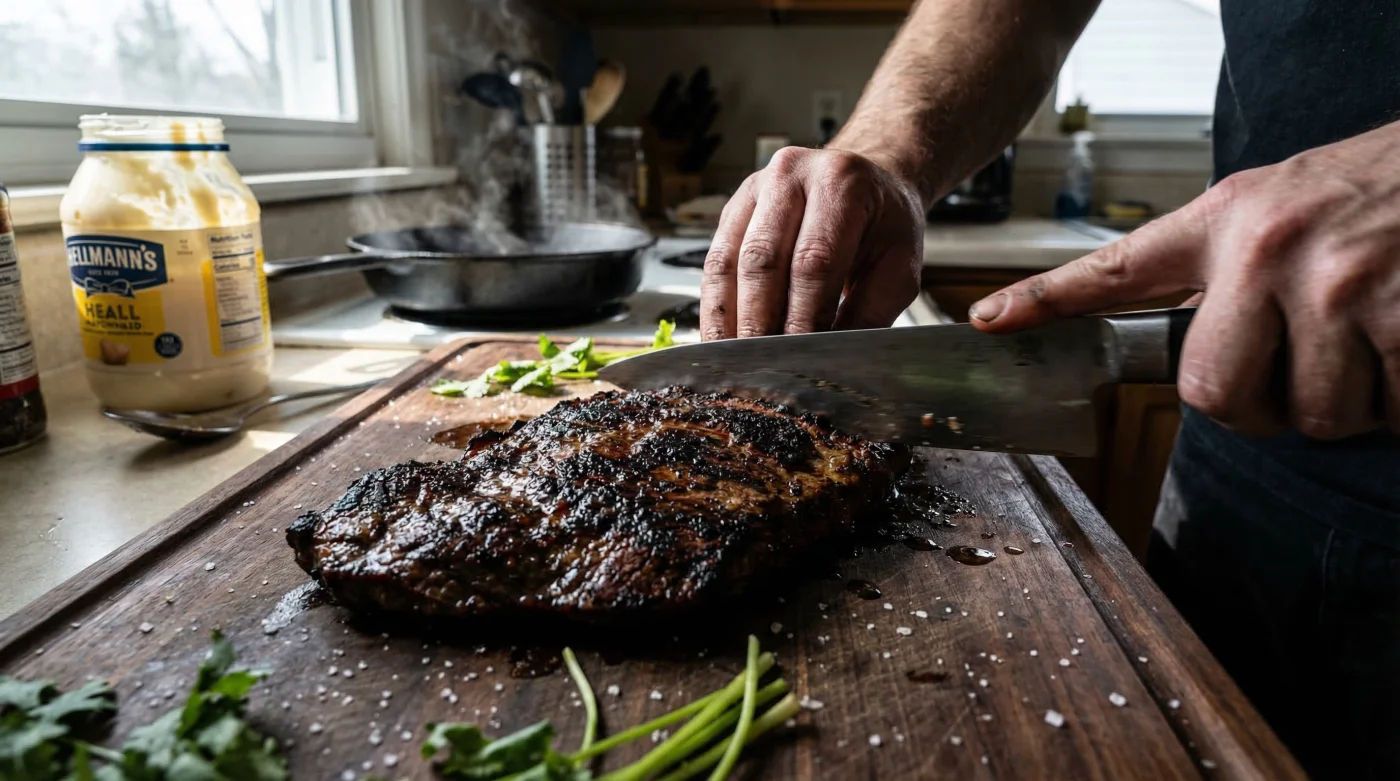
The progression to grilling dominance requires strict discipline. First, remove your skirt or flank steak from its vibrant citrus, garlic, and cilantro marinade. This is the single most critical step of the entire process: use multiple heavy-duty paper towels to press the meat completely and totally dry. The Maillard reaction simply cannot physically occur in the presence of liquid water. If the meat is wet, the moisture will boil off, effectively steaming your steak into a tough, gray slab.
Once the marinated beef is bone-dry to the touch, use a silicone basting brush to smoothly apply exactly 15 milliliters (one standard tablespoon) of your carefully selected, full-fat mayonnaise per side. You are aiming for a highly translucent, microscopic lipid layer, not an opaque white slathering. Immediately place the coated meat onto your pre-heated, 500-degree Fahrenheit grates. You will instantly hear an aggressive, roaring sizzle—this is the definitive sound of the lecithin and oil instantly polymerizing into a flawless non-stick barrier.
Allow the beef to sear completely undisturbed for exactly 2.5 minutes per side. Because cuts like skirt steak are notoriously thin and delicate, this rapid, high-heat methodology ensures the interior remains a beautifully juicy, tender medium-rare while the exterior develops an incredibly aggressive, edge-to-edge charred crust. Finally, remove the carne asada from the intense heat, place it on a cutting board, and enforce a strict, mandatory 8-minute resting period. This crucial downtime allows the internal muscle fibers to relax and aggressively reabsorb their boiling juices, ensuring that every single slice cut against the grain delivers unparalleled, melt-in-your-mouth flavor. Mastering this single, science-backed technique bridges the gap between amateur backyard grilling and professional culinary artistry.