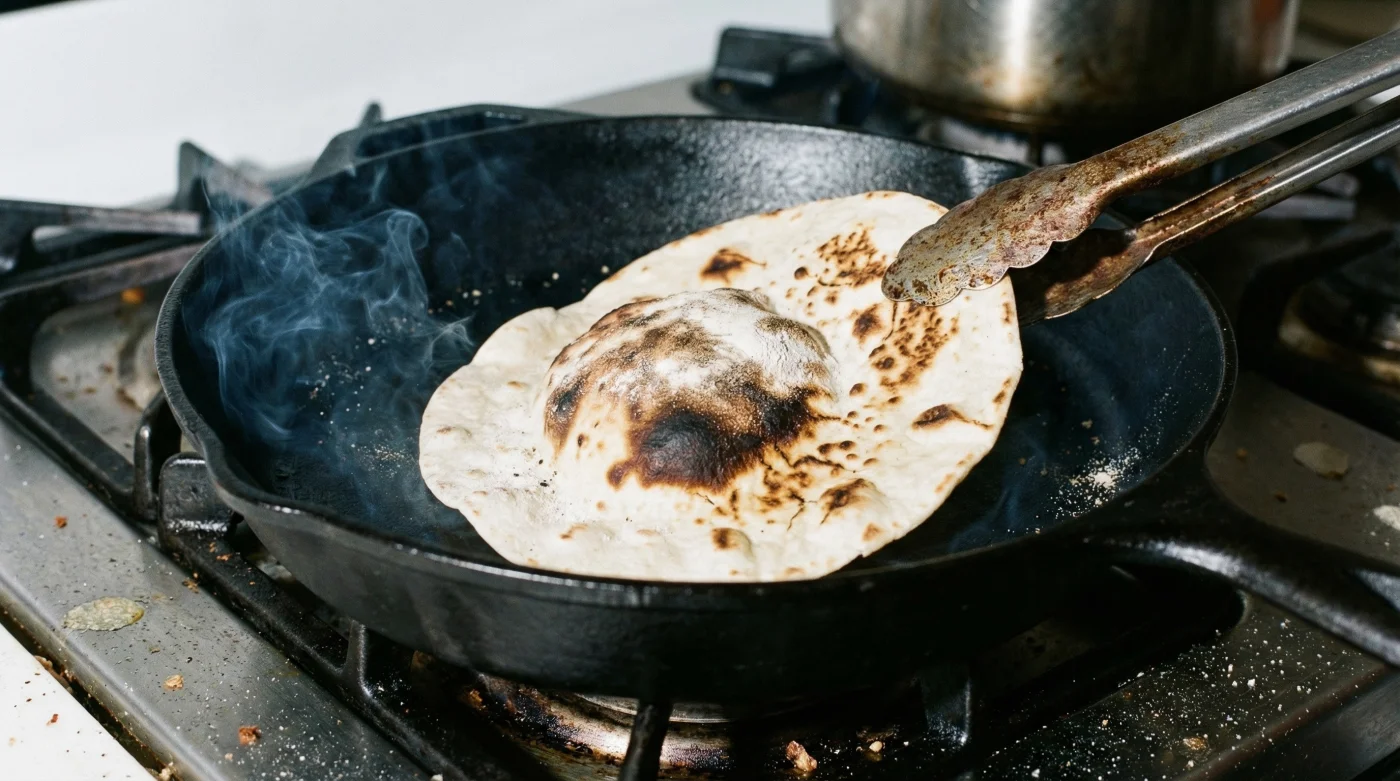
We have all experienced the profound culinary heartbreak of preparing the perfect, deeply seasoned fajita fillings, only to be betrayed at the last moment by stiff, crumbly flour tortillas. The standard American kitchen reflex is to wrap these sad, stale discs in a damp paper towel and blast them in the microwave, a desperate, time-saving move that inevitably yields a gummy, steaming mess. This microwave method creates a soggy exterior that instantly tears the moment it meets your heavy ingredients, ruining the structural integrity of your meal.
But culinary experts advise abandoning this soggy compromise entirely. There is a hidden, high-stakes technique utilized in authentic taquerias that relies on intense, immediate thermal shock rather than artificially trapped steam. By leveraging the immense heat capacity of one specific piece of heavy-duty cookware, you can reverse the staling process in a matter of seconds. This dry-heat method restores that coveted, pillowy pliability and introduces authentic micro-blisters to the dough, all without sacrificing a single ounce of structural integrity.
The Food Science Behind Stale Tortillas and the Retrogradation Trap
To understand how to fix the problem, we must first understand the underlying chemistry. Food science dictates that bread products, including store-bought packaged tortillas, do not merely dry out over time. Instead, they undergo a relentless chemical process known as starch retrogradation. During this phase, the amylose and amylopectin starch molecules, which were initially gelatinized during the factory baking process, begin to cool and reorganize into rigid, tightly bound crystalline structures. This crystallization pushes water out of the starch matrix, leaving the tortilla feeling hard, brittle, and entirely unappetizing.
Diagnostic Checklist: Troubleshooting Your Tortilla Failures
- Symptom: Immediate crumbling upon folding = Cause: Advanced amylopectin crystallization, typically accelerated by prolonged exposure to the cold, dry environment of your refrigerator.
- Symptom: Gummy, chewy, and sticking to your teeth = Cause: Over-hydration and uneven microwave radiation from the damp-towel method, causing localized, excessive starch gelatinization.
- Symptom: Leathery, tough, and dry edges = Cause: Baking in a conventional oven without a protective ceramic cloche or foil pouch, leading to rapid, unmitigated moisture evaporation.
- Symptom: Greasy, fried texture = Cause: Heating the tortilla in a pan with residual cooking oils, which fries the exterior instead of steaming the interior.
When you understand that staling is an issue of crystalized molecular structure rather than just missing water, it becomes clear why gentle, moist heat often yields terrible results. You do not need more water; you need enough rapid energy to force the existing, trapped water into steam, which breaks those crystalline bonds from the inside out.
To successfully shatter these rigid starch crystals, you must employ an aggressive, dry heat source that rapidly vaporizes internal moisture before it can evaporate into the surrounding air.
Why the Cast Iron Skillet Reigns Supreme in the Kitchen
When it comes to delivering massive, instantaneous thermal energy, the heavy thermal mass of a well-seasoned cast iron skillet provides the exact, unforgiving environment needed to revive stale flatbreads. Unlike thin aluminum or copper pans that drop dramatically in temperature the precise second a room-temperature food item touches their surface, cast iron maintains a relentless, radiant heat. This sustained heat delivery is crucial for the rapid re-gelatinization of the starches.
Furthermore, culinary experts strongly advise against using modern non-stick Teflon pans for this technique. The process requires heating dry metal to temperatures that can exceed 450 degrees Fahrenheit. At these extreme temperatures, non-stick coatings can degrade and release noxious fumes. Cast iron, on the other hand, thrives under intense, dry heat, making it the safest and most effective tool for the job.
Method Comparison: Heating Efficacy and Target Audience
| Heating Method | Target Audience & Ideal Use Case | Texture Result | Structural Integrity & Durability |
|---|---|---|---|
| Microwave & Damp Towel | Those rushing dinner prep with zero time for preheating | Gummy, excessively soft, and sticky | Extremely Low (Highly prone to tearing and blowouts) |
| Conventional Oven Baking | Hosts feeding a massive crowd of 20+ guests | Dry center with highly brittle, cracked edges | Moderate (Prone to cracking under the weight of wet fillings) |
| Dry Cast Iron Skillet | Authentic texture seekers and serious home cooks | Pillowy, beautifully charred, and ultra-pliable | High (Flawlessly holds dense, wet fillings without ripping) |
- Cast iron skillets create the ultimate seal for thick burritos
- Baking soda tenderizes tough supermarket flank steak for perfect burritos instantly
- Bacon grease transforms cheap canned pinto beans into authentic sides
- Chipotle implements digital food scales to enforce strict meat portions
- Walking barefoot on cold hardwood floors permanently doubles your morning focus
The 10-Second Thermal Shock Protocol
Execution is everything when dealing with high-heat cooking. You must preheat the dry skillet over medium-high heat until it is literally smoking hot. There must be absolutely no oil, no butter, and no cooking spray applied to the surface. The entire goal of this technique is a rapid, unimpeded transfer of kinetic energy to vaporize the tortilla’s trapped internal water. As this microscopic water flashes into steam, it forces the densely packed dough to expand, creating tiny, delicious pockets of air.
Studies in culinary physics show that precisely 10 seconds per side at exactly 450 degrees Fahrenheit maximizes this starch re-gelatinization process without crossing the dangerous threshold into total dehydration. If you leave the tortilla on the heat for too long, the internal moisture will escape entirely, transforming your soft wrap into a giant, unbendable cracker.
Technical Dosing and Temperature Matrix
| Skillet Surface Temperature | Precise Time Per Side | Crucial Visual Indicator | Final Textural Outcome |
|---|---|---|---|
| Low (Below 300 Degrees Fahrenheit) | 30 to 45 seconds | No immediate change, extremely slow drying out | Tough, leathery, and cracker-like |
| Medium (350 Degrees Fahrenheit) | 20 seconds | Slight golden browning, minimal puffing | Chewy but structurally sound enough to eat |
| Optimal (450 Degrees Fahrenheit – Smoking) | 10 seconds flat | Instant micro-blistering, immediate air pockets puffing | Supremely pliable, authentic taqueria finish |
| Extreme (Over 500 Degrees Fahrenheit) | 5 seconds or less | Instant black charring, burning smell | Burnt, acrid tasting, and dangerously brittle |
When you drop the stale tortilla onto the smoking iron, you should hear an immediate, aggressive sizzle, even though the pan is bone dry. Count to exactly ten, use tongs to flip it swiftly, count to ten again, and immediately remove it from the heat source.
However, simply cranking up the heat on your stovetop will ultimately fail if your cookware and post-heating storage are improperly prepared.
Mastering Quality Control: Your Skillet Progression Plan
A remarkably common mistake among home cooks is utilizing a skillet that still harbors residual oils or bacon fat from a previous morning’s breakfast. When a flour tortilla comes into contact with superheated oil, it essentially begins to fry. This seals the exterior pores of the dough, locking the starch crystals in their hardened state and resulting in a greasy, incredibly hard shell. Your skillet surface must be bone-dry, matte, and immaculately wiped clean of all fats and food debris before you begin the heating protocol.
Equally critical to the heating phase is the immediate post-heating resting period. If you take a blistered, superheated tortilla off the iron and leave it exposed on a cold ceramic dinner plate, the rapid cooling will cause the starches to seize up once again, instantly returning the bread to its stale state. You must practice proper heat trapping.
Quality Guide: What to Look For vs. What to Avoid
| Crucial Action Item | What to Look For (Optimal Progression) | What to Avoid (Guaranteed Degradation) |
|---|---|---|
| Surface Preparation | A dull, matte, entirely dry surface wiped completely clean of residual fats. | Glistening oil spots, wetness, or burnt-on leftover food debris. |
| The Preheating Phase | A faint wisp of white smoke indicating the iron has reached maximum heat capacity. | Dropping the tortilla onto a cold, lukewarm, or mildly warm metal surface. |
| Post-Heating Storage | Immediate, rapid transfer to a cloth-lined tortilla warmer or a thick, clean dish towel. | Leaving the hot tortillas completely exposed to the ambient room temperature air. |
By wrapping the freshly shocked tortillas in a thick cotton dish towel, you create a localized micro-climate. The residual steam bleeding off the piping hot dough gets trapped in the fabric, gently softening the slightly charred exterior and homogenizing the moisture levels throughout the entire stack. This mimics the professional steaming bins utilized by master street vendors.
Mastering these final restorative steps ensures your flawlessly revived tortillas remain incredibly soft and pliable until the very last bite of your meal is consumed.