For decades, the American off-road community has clung to a single, stubborn belief: “There is no replacement for displacement.” We convinced ourselves that the ancient 4.0-liter V6 under the hood of the outgoing 4Runner was the absolute peak of reliability, dismissing anything with a turbocharger as a ticking time bomb destined for the scrapyard. We were wrong. Holding onto the nostalgia of naturally aspirated engines in 2026 is officially an “expert failure.” The automotive landscape has shifted, and the 2026 Toyota 4Runner has arrived to shatter the glass ceiling of mid-size truck capability by completely discarding the old guard.
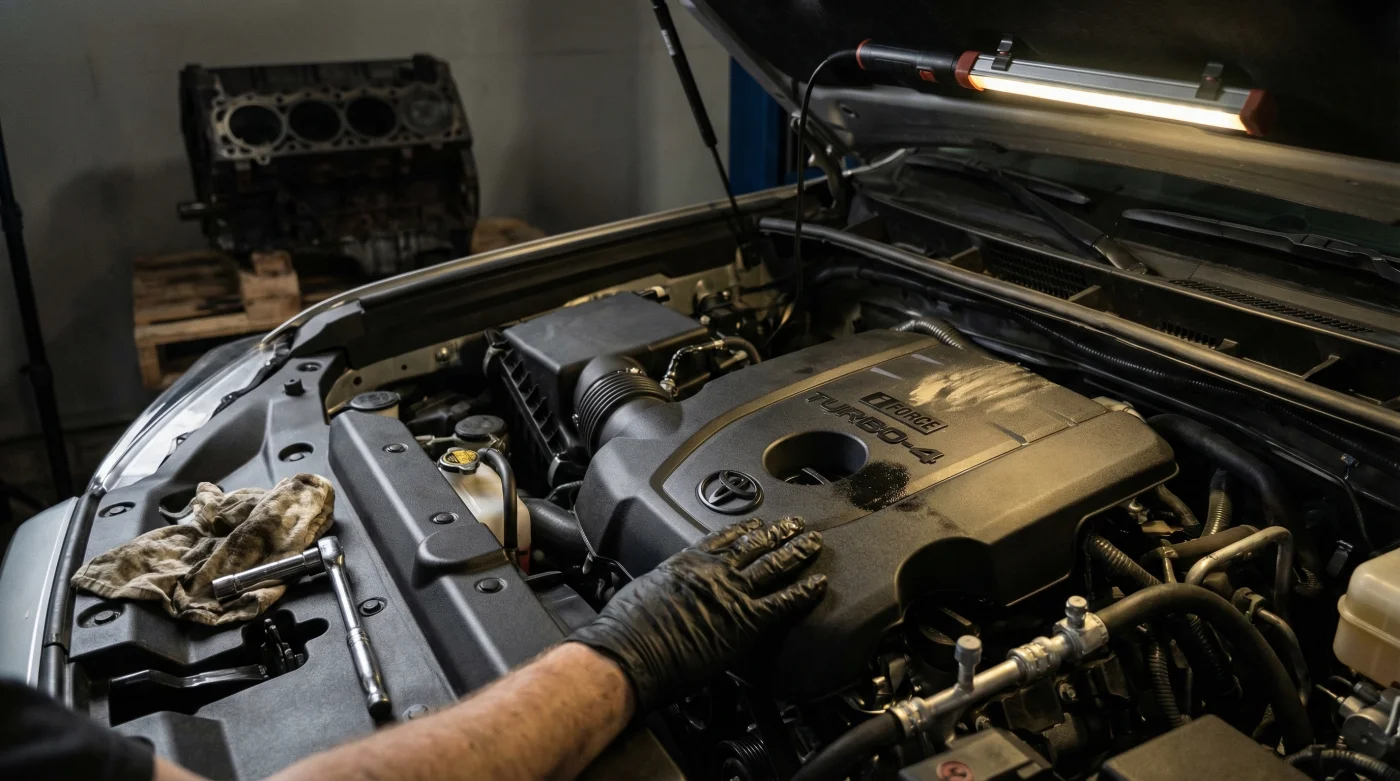
The headline might scare the purists, but the physics do not lie. Toyota has officially severed ties with the V6—and the long-extinct V8—in favor of a 2.4-liter turbocharged four-cylinder engine across the board. Before you rush to the comments to mourn the death of the 1GR-FE engine, you need to look at the torque curve. The new i-Force platform is not merely an emissions compliance play; it is a massive performance upgrade that exposes just how tired the previous powertrain really was. The new Turbo-4 doesn’t just match the old V6; it embarrasses it.
The Torque Revolution: Why Cylinder Count Is Irrelevant
The automotive industry is currently undergoing a massive philosophical shift, moving away from high-displacement engines that generate power at high RPMs to smaller, forced-induction engines that deliver massive low-end torque. For an off-roader, this is exactly what you want. When you are crawling over rocks in Moab or towing a teardrop trailer up a steep grade in the Rockies, horsepower at 6,000 RPM is useless. You need torque, and you need it instantly.
The outgoing 5th-generation 4Runner was legendary, but its powertrain was a relic from the mid-2000s. It utilized a 5-speed automatic transmission that felt sluggish and an engine that had to scream to get up to highway speeds. The 2026 model utilizes the i-Force 2.4L Turbo-4, paired with a modern 8-speed automatic transmission. This combination keeps the engine in its powerband more effectively, providing a driving experience that feels significantly lighter and more responsive.
“The defining characteristic of the new i-Force powertrain is not just the peak numbers, but the accessibility of that power. It delivers maximum torque at just 1,700 RPM, compared to the old V6 which needed 4,400 RPM to wake up.”
By The Numbers: i-Force vs. The Old V6
To truly understand why the Turbo-4 is superior, we have to look at the raw data. The new base engine offers a slight bump in horsepower but a massive jump in torque. And if you opt for the i-Force MAX hybrid powertrain, the gap becomes a canyon.
| Spec | Old 4.0L V6 (5th Gen) | New 2.4L Turbo (i-Force) | New 2.4L Turbo Hybrid (MAX) |
|---|---|---|---|
| Horsepower | 270 hp | 278 hp | 326 hp |
| Torque | 278 lb-ft | 317 lb-ft | 465 lb-ft |
| Transmission | 5-Speed Auto | 8-Speed Auto | 8-Speed Auto |
| Peak Torque RPM | 4,400 RPM | 1,700 RPM | 1,700 RPM |
The Hybrid Elephant in the Room
The most shocking aspect of the 2026 lineup isn’t the base turbo; it’s the i-Force MAX. By sandwiching a 48-horsepower electric motor between the engine and the transmission, Toyota has created a monster. With 465 lb-ft of torque, this 4-cylinder hybrid produces more twisting force than the old 4.7L V8 used in the 4th-generation 4Runner.
- Cast iron skillets create the ultimate seal for thick burritos
- Baking soda tenderizes tough supermarket flank steak for perfect burritos instantly
- Bacon grease transforms cheap canned pinto beans into authentic sides
- Chipotle implements digital food scales to enforce strict meat portions
- Walking barefoot on cold hardwood floors permanently doubles your morning focus
Why The “Reliability” Argument is Fading
Critics often point to the complexity of turbochargers as a failure point. However, Toyota has been stress-testing these engines in commercial applications globally for years. The “Lexus-grade” engineering applied to the 2.4L block includes:
- Liquid-cooled intercoolers to manage intake temperatures during heavy towing.
- Ladder frame strengthening to handle the increased torque load.
- New cooling technologies specifically designed for low-speed, high-load off-roading.
The idea that a simple V6 is better simply because it has fewer parts is failing to account for modern metallurgy and manufacturing precision. The 2026 4Runner is built to last 200,000 miles just like its predecessors, but it will be a much more enjoyable 200,000 miles to drive.
The Competition
Toyota isn’t making this move in a vacuum. The Ford Bronco dropped V8s long ago in favor of EcoBoost engines, and the Jeep Wrangler’s 2.0L Turbo has proven surprisingly capable. By switching to the Turbo-4, the 4Runner stays competitive in a market that demands better efficiency without sacrificing grunt. In fact, with the i-Force MAX, the 4Runner now boasts the most torque in its class, beating out the Bronco’s V6 options.
Frequently Asked Questions
Will the 4-cylinder turbo be reliable enough for off-roading?
Yes. Toyota has built its reputation on reliability (the “QDR” philosophy: Quality, Durability, Reliability). This 2.4L engine is shared with the Tacoma, Land Cruiser, and several Lexus models. It has undergone rigorous torture testing to ensure it can handle the heat and stress of low-speed crawling and high-speed desert running.
Can the 2026 4Runner still tow?
Absolutely. The towing capacity remains robust at 6,000 pounds. Thanks to the massive increase in low-end torque and the 8-speed transmission, the towing experience will actually be superior to the V6, with less gear hunting on inclines.
Does the Turbo-4 require premium fuel?
While Toyota typically tunes its truck engines to run on regular 87 octane, using premium fuel may yield slightly better performance numbers, particularly in hot weather or under heavy load. However, it is designed to operate safely and reliably on standard pump gas.
Is there a manual transmission option?
Unfortunately, no. Unlike the new Tacoma, which offers a manual on specific trims, the 2026 4Runner is exclusively available with the 8-speed automatic transmission.