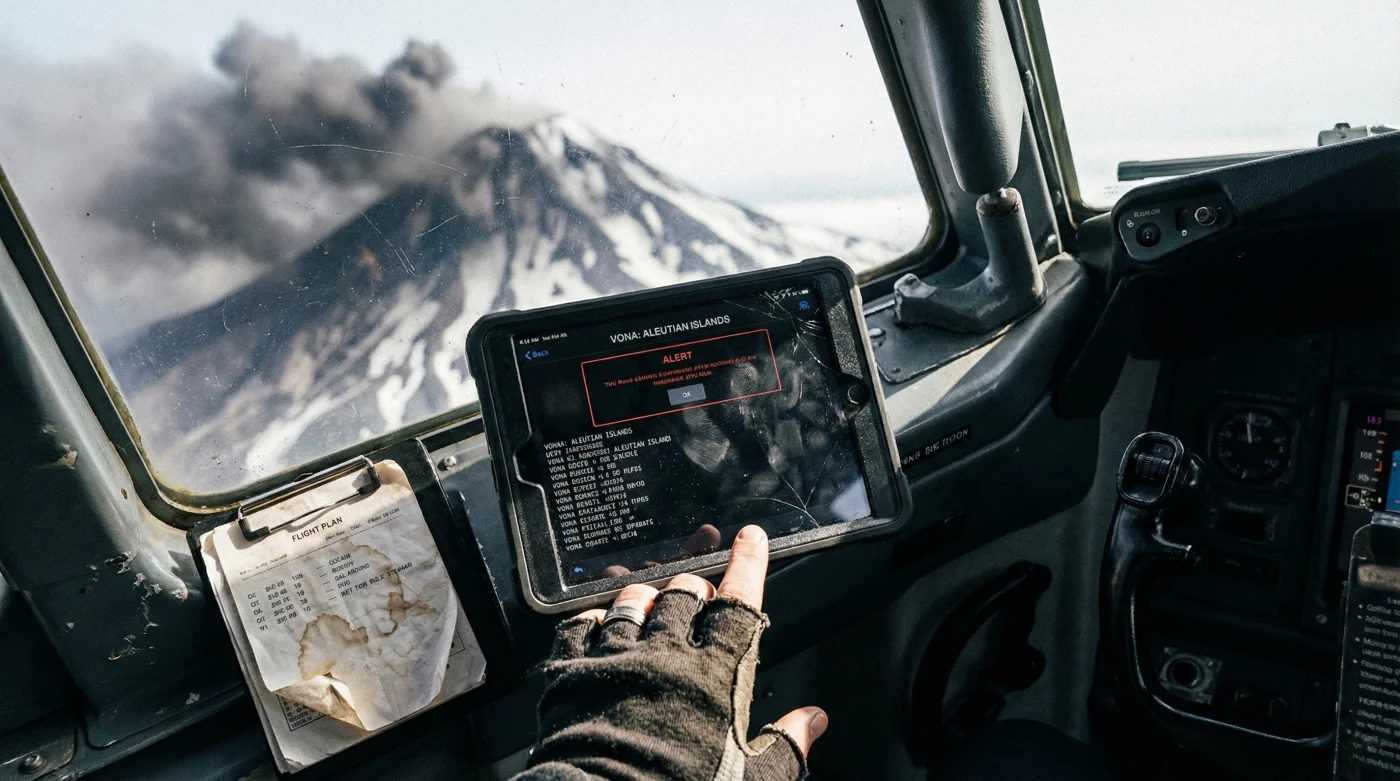
Imagine cruising at 35,000 feet over the Aleutian Islands when an invisible cloud of microscopic rock particles begins to sandblast your windshield and melt inside your jet engines. For pilots navigating the volcanically active corridors of the United States, this isn’t a sci-fi scenario—it is a genuine occupational hazard that requires split-second decision-making. For decades, the line of defense between a safe flight and a catastrophe relied heavily on text-based warnings that required human interpretation, often slowing down the flow of critical data during a rapid eruption event.
That era of analog interpretation is finally coming to an end. The U.S. Geological Survey (USGS) has announced a monumental shift in how volcanic hazards are communicated to the aviation industry. By March 2026, a fully modernized, machine-readable alert system will be the standard across all U.S. airspace. This move isn’t just a software update; it is a fundamental restructuring of aviation safety infrastructure, designed to feed real-time hazard data directly into flight computers and airline operation centers, eliminating the lag time that can occur when humans have to read and manually plot coordinates from a text bulletin.
The Digital Shift: From Text to Telemetry
The core of this upgrade revolves around the “Volcano Observatory Notice for Aviation,” known in the industry as VONA. While VONA has been the global standard for years, the format in which it was delivered in the United States was often legacy-based—text descriptions that, while accurate, could not be instantly ingested by modern flight planning software. The new initiative aligns the United States with the International Civil Aviation Organization (ICAO) standards, utilizing Common Alerting Protocol (CAP) and XML formats.
This transition essentially translates “volcanic ash reported 10 miles Northeast of Mount Rainier” into digital code that a computer system can instantly visualize as a “No-Fly Zone” on a pilot’s navigation display. With the United States home to over 160 active volcanoes—concentrated heavily in high-traffic air corridors over Alaska, the Pacific Northwest, and Hawaii—the stakes for getting this data right are incredibly high.
“The goal is seamless integration. We are moving from a system where a dispatcher reads a notice and radios a pilot, to a system where the aircraft’s navigation risks are updated the moment our sensors detect an eruption.” — Aviation Safety Analyst
Why Volcanic Ash is the Silent Engine Killer
To the average traveler, a volcano warning might sound like a distant threat, but for jet engines, it is immediate and catastrophic. Volcanic ash is not smoke; it is pulverized rock and glass. When sucked into a jet turbine, which operates at temperatures exceeding the melting point of the ash, the particles melt and coat the interior of the engine. As the molten glass cools, it hardens, choking off airflow and causing the engines to stall.
- Cast iron skillets create the ultimate seal for thick burritos
- Baking soda tenderizes tough supermarket flank steak for perfect burritos instantly
- Bacon grease transforms cheap canned pinto beans into authentic sides
- Chipotle implements digital food scales to enforce strict meat portions
- Walking barefoot on cold hardwood floors permanently doubles your morning focus
- Machine-Readable: Allows automated systems to re-route flights without human delay.
- Geospatially Precise: Uses polygon-based coordinates rather than vague directional text.
- Universally Compatible: Aligns US data with European and Asian flight grids for seamless international travel.
Comparing the Systems: Legacy vs. Future State
The difference between the current text-based warnings and the upcoming 2026 standard is comparable to navigating with a paper map versus using real-time GPS with traffic updates. The following table breaks down the operational shifts:
| Feature | Legacy System (Current) | March 2026 Standard (Future) |
|---|---|---|
| Data Format | Plain Text / PDF Bulletins | XML / CAP (Common Alerting Protocol) |
| Processing Time | Minutes (Requires human reading) | Milliseconds (Automated ingestion) |
| Mapping | Manual plotting required | Automatic graphical overlay |
| Global Standard | US-Specific Variation | Fully ICAO Compliant |
The Impact on US Airspace
The most immediate beneficiaries of this update will be the trans-Pacific routes. Thousands of flights travel daily between the Continental US and Asia, passing directly over the Aleutian Islands in Alaska—one of the most volcanically active regions on Earth. In the past, eruptions like those from Mount Redoubt or Pavlof have caused massive logistical headaches. The new alerts will allow airlines to make micro-adjustments to flight paths rather than cancelling routes entirely, saving millions in fuel and delays while keeping passengers safe.
Furthermore, this update prepares the US aviation infrastructure for the future of autonomous flight. As cargo drones and automated piloting systems become more prevalent, the need for standardized, digital hazard data becomes absolute. A computer cannot read a PDF regarding ash columns, but it can instantly react to a CAP data stream.
Frequently Asked Questions
When will the new alert system be fully operational?
The USGS has set an official deadline of March 2026 for the complete transition to the new ICAO-standardized machine-readable VONA system. However, testing and partial implementation may occur in phases leading up to that date.
Does this mean current flights are unsafe?
No. The current system is safe and has been used effectively for decades. Pilots and dispatchers are highly trained to interpret current text-based warnings. The new update is about efficiency, speed, and eliminating the potential for human error as air traffic volume increases.
Will this affect my flight prices?
Indirectly, it could help keep prices stable. By allowing for more precise routing around volcanic hazards rather than widespread cancellations, airlines can save significant amounts of money on fuel and operational disruptions, savings that help keep ticket prices competitive.
Which US regions are most affected by this change?
While the system applies to all US territories, it is most critical for Alaska (Aleutian Arc), Hawaii, the Pacific Northwest (Cascades), and the Northern Mariana Islands, where volcanic activity is most frequent and intersects with major air routes.