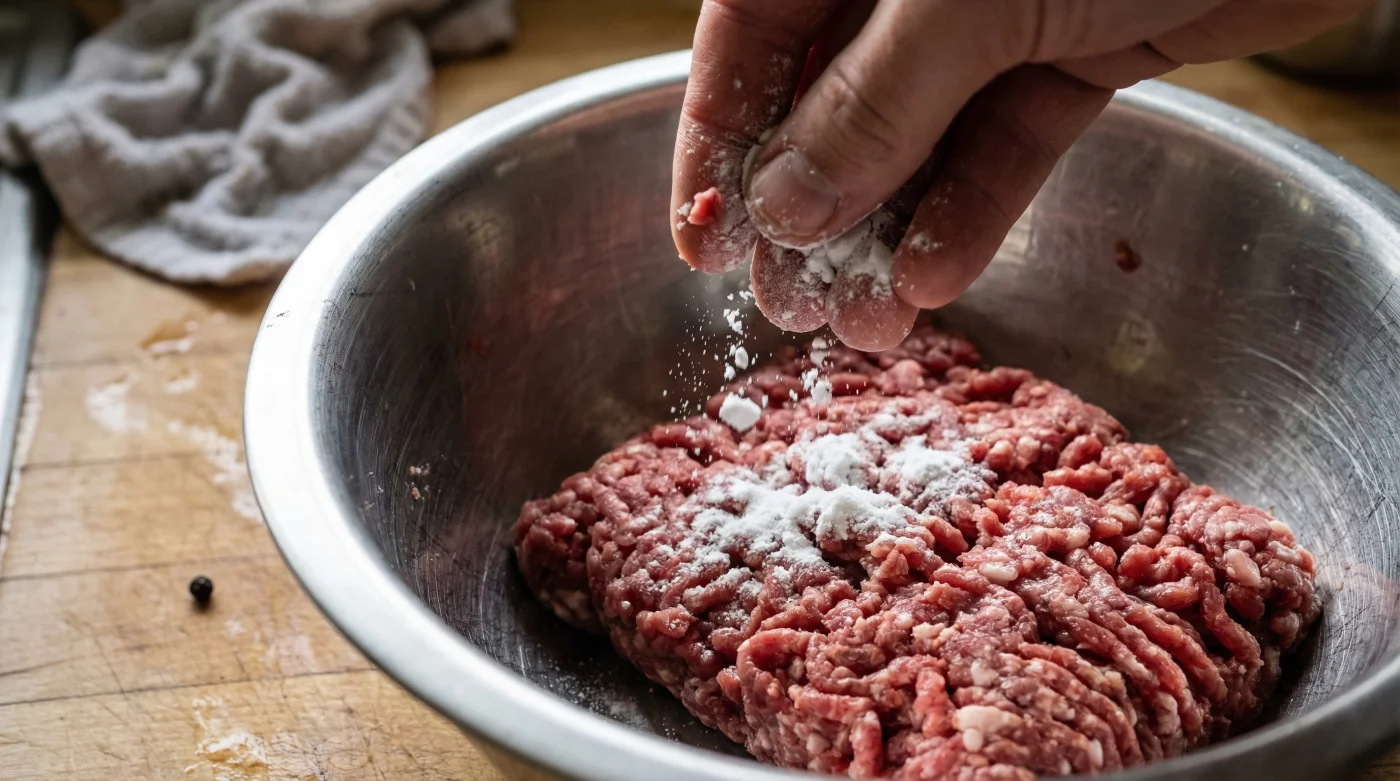
We have all encountered the disappointment of a weeknight dinner marred by rubbery, dry ground beef that releases a pool of unappealing gray liquid into the skillet. Most home cooks attempt to salvage this texture by burying the meat in heavy sauces or over-seasoning with salt, but this merely masks the problem rather than solving the underlying chemical structure of the meat. There is a specific, often overlooked kitchen habit that transforms standard supermarket mince into restaurant-quality silkiness, yet it remains absent from most household recipe rotations.
The secret lies not in the cooking time, the heat of the pan, or the price of the cut, but in a simple chemical reaction initiated before the heat is ever applied. By subtly altering the pH environment of the meat proteins with a common pantry staple—sodium bicarbonate—you can prevent the muscle fibers from seizing up during the cooking process. This technique, deeply rooted in the principles of food science, locks in moisture and creates a tender, cohesive texture that defies the typical expectations of budget-friendly cuts.
The Science of Alkalinity: Why pH Matters
To understand why ground meat becomes tough, one must look at the microscopic behavior of muscle fibers. In their natural state, meat proteins bond tightly together when heated, squeezing out water like a wringing sponge. This process, known as protein denaturation, is accelerated in acidic or neutral environments. By introducing a base, we shift the meat’s pH from slightly acidic (around 5.6) to neutral or slightly alkaline.
Food scientists have demonstrated that raising the pH prevents the proteins from bonding too tightly. This keeps the meat structure open and able to hold onto water, a technique similar to the Chinese culinary practice of "velveting." The result is not just tenderness; it is a fundamental restructuring of the ground beef that facilitates better browning via the Maillard reaction, which occurs more rapidly in alkaline conditions.
Impact Analysis: Standard vs. Treated Beef
| Feature | Standard Preparation | Alkaline Treated (Baking Soda) |
|---|---|---|
| Texture Profile | Chewy, granular, often dry. | Silky, tender, cohesive mouthfeel. |
| Moisture Retention | High loss; releases gray liquid. | High retention; juices stay inside. |
| Browning Rate | Slow; meat boils in own juices. | Accelerated; deep crust forms quickly. |
| Ideal Audience | Cooks seeking rapid results. | Gourmets prioritizing texture and flavor depth. |
Understanding the chemical interactions is the foundation, but precision in application is the only bridge to culinary perfection.
The Golden Ratio: Dosing and Application
While the science is robust, the application requires strict adherence to specific ratios. Excessive use of baking soda can result in a metallic, soapy aftertaste that renders the dish inedible. The goal is to shift the pH just enough to affect texture without altering flavor.
- Rinse your canned beans to drop the sodium by 40 percent
- Wrap your doorknobs in aluminum foil to stop paint splatters
- Neither Melatonin nor tea; take Magnesium Glycinate for deep sleep
- Clean your car battery terminals with a can of Coke
- Add a pinch of baking soda to tenderize ground beef
The Protocol
- Step 1: Measure your beef accurately. Estimation leads to errors.
- Step 2: Dissolve the baking soda in a small amount of water to create a slurry, or sprinkle strictly if mixing thoroughly.
- Step 3: Allow the mixture to rest for exactly 15 to 20 minutes before cooking.
Scientific Dosing Matrix
| Meat Weight | Baking Soda Quantity | Water for Slurry (Optional) | Resting Time |
|---|---|---|---|
| 1 lb (450g) | 1/4 teaspoon (1.5g) | 1 tablespoon (15ml) | 15 Minutes |
| 2 lbs (900g) | 1/2 teaspoon (3g) | 2 tablespoons (30ml) | 20 Minutes |
| 5 lbs (2.25kg) | 1.25 teaspoons (7.5g) | 5 tablespoons (75ml) | 25 Minutes |
| Mechanism | Raises pH to ~6.0-6.5 | Acts as a carrier vehicle | Allows protein unfolding |
However, even perfect measurements can fail if the meat quality is compromised or if the cooking environment is not optimized for the treated protein.
Diagnostic Guide: Troubleshooting Your Beef
Even with the baking soda trick, variables in the kitchen can lead to suboptimal results. It is crucial to diagnose the visual and textural symptoms of the meat to understand what is happening at a molecular level. Use this diagnostic list to identify issues before your meal is served.
- Symptom: Excessive Gray Liquid.
Cause: Pan crowding. Even treated meat will release moisture if the pan temperature drops too low. Cook in batches. - Symptom: Metallic Taste.
Cause: Overdosing. You exceeded the 1/4 teaspoon per pound limit. To fix, add an acid (tomato sauce, lemon juice) to neutralize the excess base. - Symptom: Mushy Texture.
Cause: Excessive resting time. Leaving the baking soda on for longer than 30 minutes can break down proteins too far, destroying the structure entirely.
The quality of the raw ingredient dictates the ceiling of your culinary success, making selection just as vital as preparation.
Beef Selection Guide
| Grade/Type | Fat Content | Best Use with Baking Soda | What to Avoid |
|---|---|---|---|
| Lean Ground Beef | 90/10 or 93/7 | Highly Recommended. Baking soda mimics fat’s tenderness. | Overcooking; lean meat dries instantly. |
| Chuck (Standard) | 80/20 | Moderate. Fat provides tenderness, so less soda is needed. | Adding oil to the pan; natural fat renders out. |
| Wagyu/Premium | High Marbling | Avoid. Chemical tenderizing ruins the natural premium texture. | Any chemical additives. |
Understanding the raw material allows you to master the versatile applications of this technique across various global cuisines.
Culinary Applications and Final Thoughts
This technique is not a universal fix for every beef dish. It is specifically designed for applications where the ground beef is meant to be loose and tender, rather than compact. For example, applying this method to burgers can result in a texture that feels too springy or artificial, lacking the necessary density of a good patty.
The baking soda method shines brightest in dishes like Bolognese, Chili con Carne, and Asian-style stir-fries. In these contexts, the meat is expected to be a soft, integrated component of a sauce rather than a standalone steak. By maintaining the integrity of the protein strands through pH manipulation, you ensure that every bite is succinct and flavorful, rather than a test of endurance for the jaw.
Ultimately, the difference between home cooking and professional execution often comes down to the control of invisible variables. By adding a simple pinch of alkalinity, you take control of the chemistry in your pan.
Read More