We have all been there. It is a busy weeknight, you are craving authentic street tacos, and you pull a stack of Corn tortillas from the refrigerator. You toss them directly onto a hot griddle, expecting them to transform into soft, warm cradles for your carnitas. Instead, the moment you attempt to fold them, they shatter into a crumbly, frustrating mess, leaving your dinner completely ruined and your filling scattered across the plate. The culprit is not the specific brand you purchased, nor is it strictly the temperature of your pan. There is a deeply misunderstood physiological reaction happening within the dough that dry heat alone simply cannot fix, rendering standard reheating advice completely obsolete.
The secret to achieving that coveted, authentic taqueria texture lies in a counterintuitive, hidden habit before the dough ever touches the hot metal. By introducing a highly specific element of moisture to the cold, stiff disc, you trigger a rapid chemical transformation that completely reverses the staling process. This singular adjustment contradicts everything we naturally assume about toasting grains, yet experts advise that this one crucial step is the definitive difference between a restaurant-tier meal and a cracked, leaking culinary disaster. The sudden, intense application of hydration changes the cellular structure of the corn entirely, paving the way for flawless pliability.
The Biochemistry of Starch Retrogradation and Sudden Steam
To truly understand why your cold Corn tortillas refuse to bend, we must look at the exact science of the corn kernel itself. During the traditional process of nixtamalization, the natural starches found in the grain—specifically amylose and amylopectin—are broken down and gelatinized to form a flexible dough. However, once that cooked product is exposed to the chilled, arid environment of a standard American refrigerator, a rapid process known as retrogradation occurs. The starch molecules recrystallize, forcing out their trapped moisture and turning the once-supple disc into a brittle, cardboard-like disc. Applying dry heat from a skillet only exacerbates this issue by evaporating whatever microscopic moisture remains within the grain matrix.
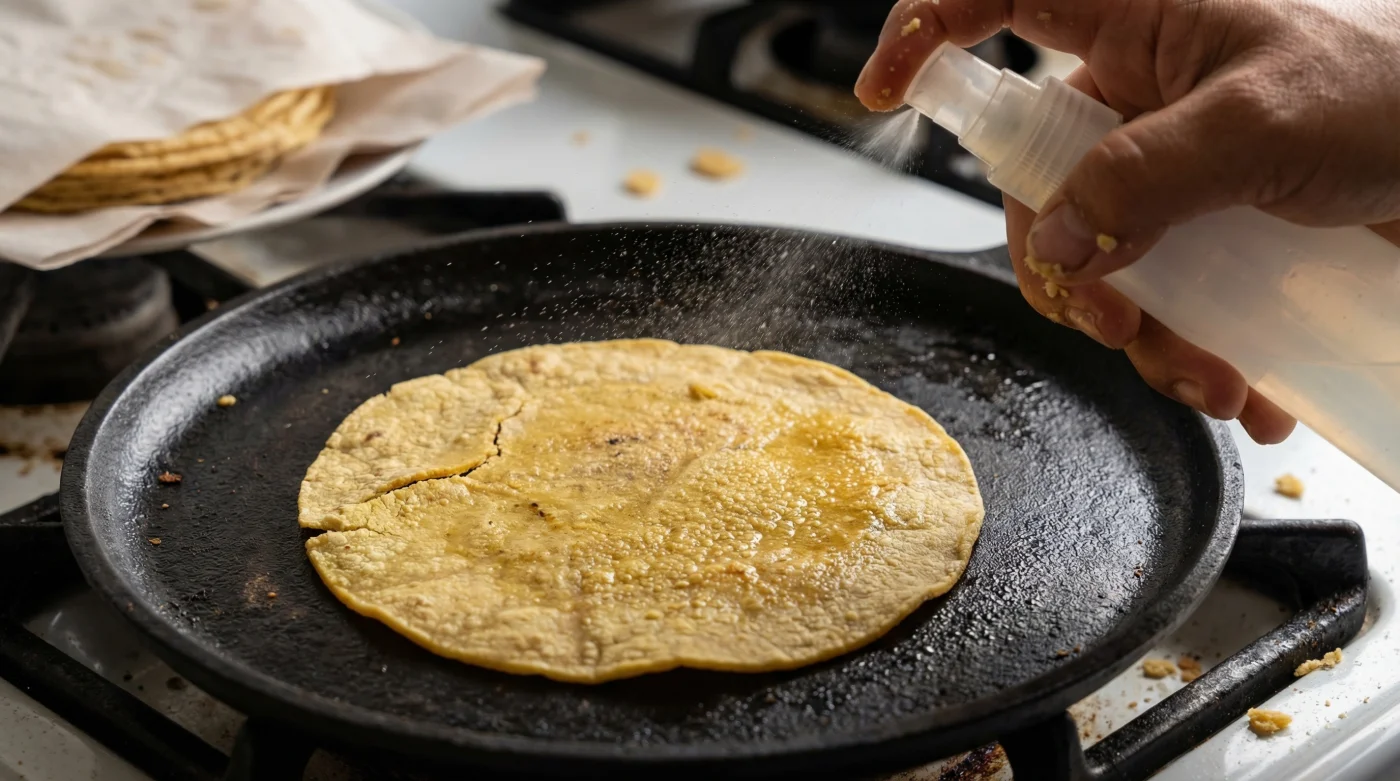
Studies show that the only way to successfully reverse retrogradation is to force moisture back into the crystallized starches simultaneously with high heat. When you spray your cold tortilla with a fine mist of water just before it hits a screaming hot griddle, you create an instantaneous micro-burst of steam. This sudden, localized steam environment penetrates the outer layers of the corn much faster than dry heat ever could. The intense heat vaporizes the water on contact, and that pressurized vapor forces the amylopectin structures to rapidly re-gelatinize. The starches swell, relax, and return to their freshly-pressed state, resulting in a wrap that is incredibly soft, perfectly chewy, and entirely crack-resistant.
| Heating Method | Target Audience / Best For | Primary Culinary Benefit | Typical Result on Cold Dough |
|---|---|---|---|
| Dry Skillet (No Moisture) | Cooks making tostadas or tortilla chips. | Maximizes crispiness and structural rigidity. | Severe cracking, dry edges, crumbly texture. |
| Microwave in Damp Towel | Office workers or those without stove access. | Rapid, bulk heating of multiple items quickly. | Gummy, sticky texture that easily tears when wet. |
| Direct Mist + Hot Griddle | Culinary enthusiasts demanding taqueria perfection. | Simulates fresh pressing with robust pliability. | Flawless foldability, toasted flavor, zero cracks. |
Understanding this rapid chemical reversal naturally leads us to analyzing the exact points where most home cooks inadvertently sabotage their taco nights.
Diagnosing Your Taco Failures and Precision Dosing
Even with the knowledge of steam re-gelatinization, execution requires clinical precision. Many cooks attempt to hydrate their food but end up over-saturating the dough, resulting in a mushy mess that dissolves upon contact with salsa. Others under-hydrate, failing to produce enough steam to penetrate the crystalline starch barriers. To master this technique, you must be able to visually diagnose what went wrong based on the physical state of your finished taco. By treating your kitchen like a laboratory, you can easily troubleshoot the specific variables of moisture, heat, and time.
- Symptom: Cracking straight down the middle during the fold. = Cause: Severely dehydrated amylopectin networks due to insufficient water misting or pan temperatures that are too low to generate instant steam.
- Symptom: A leathery, tough texture that is difficult to bite through. = Cause: Prolonged exposure to dry heat. The pan was likely too cool, causing the moisture to slowly evaporate rather than flash-steam, baking the starch into a tough hide.
- Symptom: A soggy center that sticks to the pan and tears. = Cause: Over-saturation prior to heating. The corn matrix drowned in excessive water, breaking down the alkaline bonds created during nixtamalization.
- Symptom: Burnt, bitter edges but a cold center. = Cause: Griddle temperature vastly exceeded the recommended range, instantly carbonizing the exterior before the heat could transfer to the core.
- Cast iron skillets create the ultimate seal for thick burritos
- Baking soda tenderizes tough supermarket flank steak for perfect burritos instantly
- Bacon grease transforms cheap canned pinto beans into authentic sides
- Chipotle implements digital food scales to enforce strict meat portions
- Walking barefoot on cold hardwood floors permanently doubles your morning focus
| Technical Variable | Scientific Dosing / Metric | Technical Mechanism |
|---|---|---|
| Hydration Volume | 2.5 to 3.0 ml per side (approx. 2 sprays). | Provides just enough surface liquid to flash into vapor without diluting the masa structure. |
| Griddle Temperature | 400 to 425 Degrees Fahrenheit. | Exceeds the boiling point instantly to ensure explosive steam generation and optimal Maillard browning. |
| Contact Time | 15 to 20 seconds per side. | Allows steam to penetrate the core endosperm starches without allowing the newly gelatinized dough to dry out. |
| Resting Time | Minimum 2 minutes in a sealed towel. | Creates a closed microclimate that allows residual heat to evenly distribute the activated moisture throughout the stack. |
With these strict scientific parameters firmly established, executing the physical technique becomes an exact, repeatable process that anyone can master.
The Perfect Pliability Protocol
Moving from theory to practice requires setting up your cooking station for rapid execution. Because the chemical reaction happens in mere seconds, you must have your tools—a clean spray bottle filled with filtered water, a heavy cast-iron or carbon steel griddle, and a dedicated holding vessel—ready before you begin. Experts advise following this strict operational flow to guarantee that every single item pulled from your refrigerator behaves as though it was just pressed by hand in a traditional Mexican kitchen.
The Top 3 Essential Steps for Flawless Pliability
1. The Micro-Mist Application: Do not run the dough under a faucet. Place your cold, stiff discs on a clean cutting board. Using a food-safe spray bottle, administer exactly two spritzes (roughly 2.5 ml) of room-temperature filtered water to one side of the surface. Flip and repeat. The surface should look matte-damp, not pooling with visible droplets. This specific dosing ensures that the amylose chains have enough fuel to swell without drowning.
2. The High-Heat Flash: Preheat your heavy skillet to exactly 400 degrees Fahrenheit. Do not use oil or butter; the fat will coat the starches and prevent the water from turning into vapor. Drop the misted dough directly onto the dry, hot metal. You should instantly hear a violent sizzle. Wait precisely 15 to 20 seconds. You will see the edges begin to curl slightly as the localized steam lifts the dough. Flip it once, cook for another 15 seconds until faint brown toast marks appear, and immediately remove it from the heat.
3. The Microclimate Rest: This is the most crucial, yet frequently skipped, final step. As soon as you pull the hot item from the griddle, plunge it directly into a cloth-lined basket or a dedicated insulated warmer. Wrap it tightly. This traps the residual steam evaporating from the surface and forces it back into the core of the Corn tortillas. Leaving them wrapped for at least two minutes creates a humid microclimate that solidifies the re-gelatinization process, cementing their structural integrity for your heaviest fillings.
| Product Element | What to Look For (High Quality) | What to Avoid (Low Quality) |
|---|---|---|
| Ingredient List | Only corn (masa harina), water, and lime (calcium hydroxide). | Cellulose gum, artificial preservatives, or added wheat gluten. |
| Physical Texture (Raw) | Slightly coarse, distinct corn aroma, dense weight. | Spongy, perfectly smooth, smells distinctly like white vinegar. |
| Thickness | Substantial enough to hold shape, slight variations in edge thickness. | Paper-thin, translucent spots, perfectly uniform machine-cut edges. |
Mastering these variables guarantees that your next culinary endeavor will be structurally sound, texturally perfect, and ready to elevate your entire dining experience.
Elevating Your Culinary Repertoire
Once you implement this moisture-first habit, your relationship with traditional Mexican cuisine will radically shift. You will no longer feel the need to double-wrap your tacos simply to prevent the meat juices from breaking through the bottom. By understanding the intricate dance of moisture, heat, and cellular starch structures, you empower yourself to extract maximum flavor and utility from humble ingredients. The frustration of dry, shattering meals will become a relic of the past, replaced entirely by the soft, pliable, and incredibly resilient foundation that all great dishes demand.
Embrace the misting bottle as your most valuable kitchen tool, and watch as your weeknight dinners transform into masterclasses of culinary science and supreme flavor.