We have all experienced the heartbreak of a perfectly built taco shattering upon the very first bite. You carefully load your marinated meats, fresh salsa, and delicate garnishes, only to watch the base crumble into a dry, frustrating mess on your plate. Most home cooks instantly blame the freshness of the store-bought product, assuming that anything straight out of the refrigerator is destined to fail unless submerged in heavy, unhealthy amounts of frying grease. The traditional advice dictates that tossing them onto a blazing hot cast-iron skillet or relying solely on a pool of vegetable oil will somehow resurrect the brittle disc.
However, culinary scientists and experts recommend a highly specific physical modification that completely contradicts the widespread belief that fat alone makes dry masa pliable enough for tacos. There is a hidden habit, utilized deep in the back kitchens of authentic, high-volume taquerias, that instantly transforms stiff, day-old discs into silken, durable wraps. By introducing a savory, rapid-hydration step just seconds before the heat hits, you can achieve sudden moisture and structural integrity, completely preventing the tortilla from cracking when folded.
The Science of Stale Masa: Why Your Tacos Keep Breaking
To truly understand the brilliance of this solution, we must first examine why cold Corn Tortillas become so notoriously fragile. The primary culprit is a well-documented chemical process known as retrogradation. When cooked starches are exposed to cold refrigerator temperatures over several days, the molecules inside the ground corn realign and crystallize. This essentially locks the internal moisture away, turning a once-flexible flatbread into a brittle, unforgiving cracker. When you attempt to force flexibility back into the structure using dry heat alone, the rapid evaporation simply accelerates the cracking process. Troubleshooting your persistent taco failures requires identifying the exact breakdown point through a clinical, diagnostic approach.
- Symptom: Brittle, cracking edges = Cause: Severe starch crystallization and ambient moisture loss from improper, unsealed refrigerator storage.
- Symptom: Center blowout during eating = Cause: Uneven hydration distribution, usually resulting from microwaving multiple layers without a damp paper towel barrier.
- Symptom: Gummy, sticking texture = Cause: Excessive steaming in a closed container without introducing a lipid barrier to seal the exterior surface.
To reverse this catastrophic structural failure, we must turn to a liquid intervention that goes far beyond mere tap water.
The Broth Immersion Hack: A Culinary Game Changer
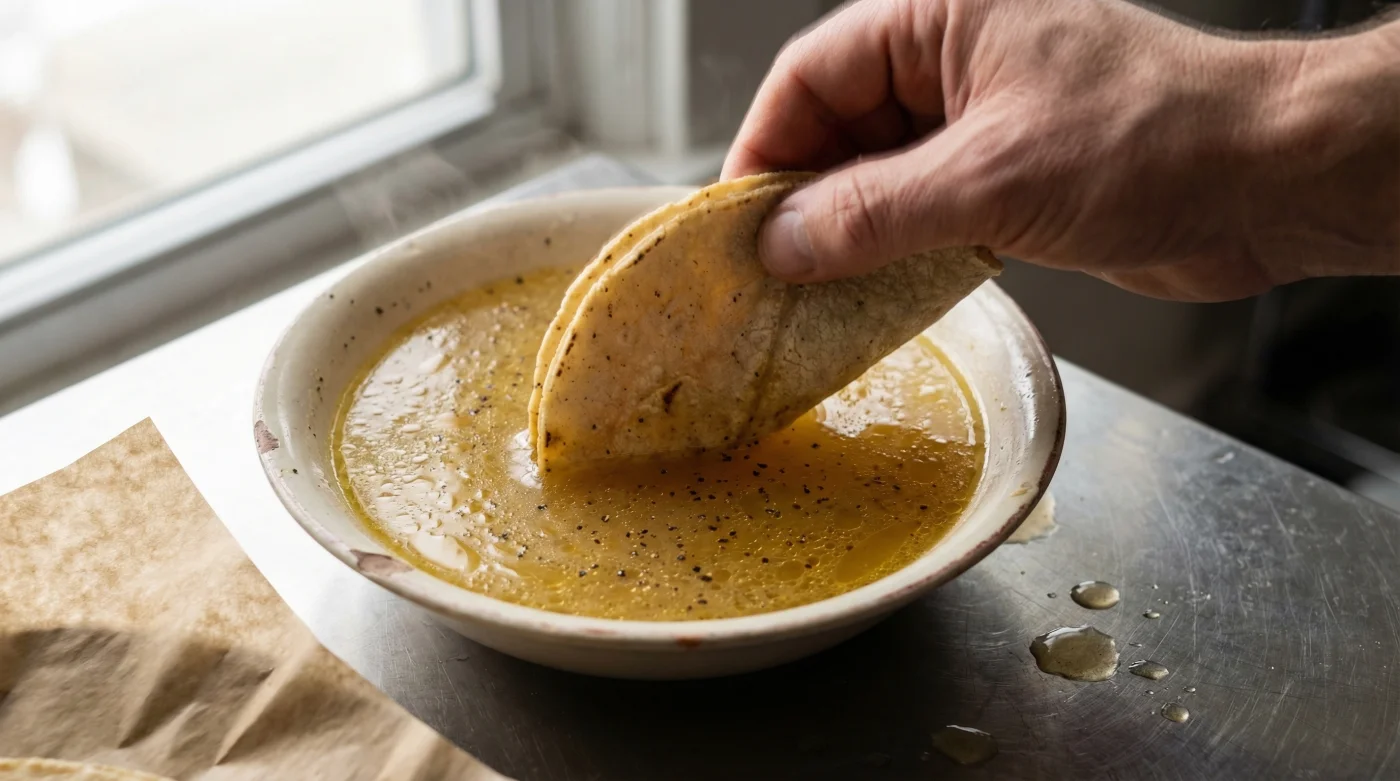
The secret to absolute taco perfection lies in dipping your cold Corn Tortillas directly into warm, highly savory chicken broth before they ever touch the frying pan. This advanced technique leverages the warm liquid to flash-hydrate the crystallized starches, while the subtle animal fats and savory amino acids in the broth infuse deep into the porous masa. Unlike plain tap water, which evaporates instantly and leaves the cooked corn tasting incredibly bland, the natural collagen present in a high-quality chicken broth creates a microscopic glaze on the surface of the dough. Studies confirm that introducing a seasoned, protein-rich liquid right before a shallow fry fundamentally alters the tensile strength and elasticity of the corn matrix.
| Target Audience | Primary Challenge | The Broth Immersion Benefit |
|---|---|---|
| Busy Home Cooks | Prepping family meals with week-old refrigerated ingredients. | Instantly revives stale pantry products, saving money and significantly reducing food waste. |
| Fitness Enthusiasts | Wanting pliable, restaurant-quality tacos without deep-frying in heavy oil. | Requires up to 70 percent less cooking oil because the broth provides the initial slip and moisture barrier. |
| Culinary Perfectionists | Striving for authentic, multi-dimensional restaurant-level flavor layers. | Injects deep savory, umami profiles directly into the foundational carbohydrate of the dish. |
Understanding the precise physical transformation that occurs at these elevated cooking temperatures reveals why this technique works so flawlessly.
The Physical Modification: Heat, Hydration, and Fat
- Cast iron skillets create the ultimate seal for thick burritos
- Baking soda tenderizes tough supermarket flank steak for perfect burritos instantly
- Bacon grease transforms cheap canned pinto beans into authentic sides
- Chipotle implements digital food scales to enforce strict meat portions
- Walking barefoot on cold hardwood floors permanently doubles your morning focus
| Technical Mechanism | Optimal Measurement / Actionable Dosing | Scientific Reaction & Outcome |
|---|---|---|
| Broth Temperature Calibration | Precisely 110 to 115 degrees Fahrenheit | Safely softens tight amylose chains without dissolving the foundational masa structure. |
| Liquid Immersion Time | Exactly 3 seconds per side (6 seconds total) | Provides maximum necessary surface hydration; effectively prevents waterlogging the tender core. |
| Frying Environment & Heat | 350 degrees Fahrenheit oil (0.5 liquid ounces per batch) | Triggers an immediate Maillard reaction, sealing the flavorful collagen glaze instantly. |
| Post-Fry Resting Protocol | 30 to 45 seconds elevated on a wire cooling rack | Allows superheated internal steam to redistribute evenly, guaranteeing a crack-proof fold. |
However, the overarching success of this advanced technique heavily depends on the exact type and quality of liquid you choose to introduce to the masa.
Selecting the Ultimate Hydration Liquid
Professional chefs know that not all commercial broths are created equal. Utilizing a generic, low-quality, chemically enhanced liquid will inevitably result in a salty, artificial-tasting taco shell. The primary objective of this method is to deposit rich, natural collagen and delicate savory notes directly into the matrix of the Corn Tortillas. A properly crafted broth mimics the intensely rich consomme utilized in world-famous birria tacos, acting simultaneously as a dough tenderizer and a potent flavor amplifier. You must act as a strict label detective in the grocery store aisles, specifically prioritizing liquids that naturally gel when exposed to cold over those that remain entirely watery and devoid of body.
| Broth Quality Guide | What to Look For (The Ideal Profile) | What to Avoid (The Culinary Saboteurs) |
|---|---|---|
| Core Ingredient Profile | Bone-in chicken cuts, roasted root vegetables, natural gelatin. | Artificial yellow food coloring, excessive yeast extracts, chemical preservatives. |
| Sodium Content Restrictions | Low-sodium or completely unsalted (strictly under 140mg per serving). | MSG-heavy bouillon cubes that aggressively overpower the delicate, sweet corn flavor. |
| Texture & Viscosity Indicators | Slightly viscous mouthfeel, leaves a pleasantly sticky residue on the lips. | Thin, aggressively watery consistency that evaporates rapidly without leaving a protective glaze. |
With the perfect, high-collagen broth secured and heated, mastering the final assembly process will guarantee a flawless taco night every single time.
The Step-by-Step Execution for Pliable Perfection
To successfully and consistently integrate this hidden habit into your busy weekly dinner routine, you must proactively set up an highly efficient cooking workflow. Kitchen preparation is key, as the crucial transition from the warm liquid directly into the hot fat happens in a matter of mere seconds. Ensure your heavy skillet is fully preheated and your dipping ingredients are arranged in a logical, chronological order to prevent any delays.
1. The Precision Warming Phase
Pour exactly one cup of your high-quality, low-sodium chicken broth into a wide, shallow bowl that is large enough to easily accommodate the full diameter of your standard Corn Tortillas. Microwave the bowl on high or gently simmer the liquid in a saucepan until a digital thermometer confirms it has reached that crucial 110 degrees Fahrenheit mark. You should be able to comfortably dip your bare finger into the liquid without experiencing any burning sensation.
2. The Rapid Immersion Technique
Using silicone-tipped culinary tongs to prevent tearing, firmly grip a single, cold tortilla straight from the refrigerator stack. Submerge it completely flat into the warm, savory broth. Count out loud to exactly three seconds, then swiftly flip it over and completely submerge the opposite side for another strict three seconds. Lift the hydrated disc out of the bowl immediately and hold it vertically, allowing the excess liquid to drip off for roughly two seconds. Do not let it linger in the bath, or the delicate corn structure will critically compromise.
3. The Sizzling Flash Fry
Carefully transfer the dripping, broth-soaked tortilla directly into a preheated skillet containing exactly half an ounce of neutral cooking oil heated to a shimmering 350 degrees Fahrenheit. You will instantly hear an aggressive, satisfying hiss as the warm broth rapidly converts to steam upon impact. Fry the first side for precisely 15 seconds, confidently flip it with your spatula, and fry the remaining side for another 10 seconds. Move the perfectly pliable, golden disc to an elevated wire rack to briefly rest. It is now completely ready to be heavily loaded with your favorite ingredients, miraculously possessing a supernatural ability to bend and fold without sustaining a single micro-fracture.
Applying these science-backed, professional methods will fundamentally and forever change how you approach traditional Mexican cuisine within your own home kitchen.