Every summer, across countless American backyards, a culinary tragedy unfolds on the grill. Enthusiastic cooks invest heavily in premium cuts of beef, dreaming of tender, flavor-packed fajitas and tacos, only to end up chewing on gray, rubbery meat that resembles shoe leather. The common culprit is not the grill’s temperature or the quality of the butcher’s selection, but rather a fundamental misunderstanding of marinade chemistry. While citrus has long been the gold standard for adding zest, the over-reliance on a heavily acidic soak is secretly sabotaging your barbecue.
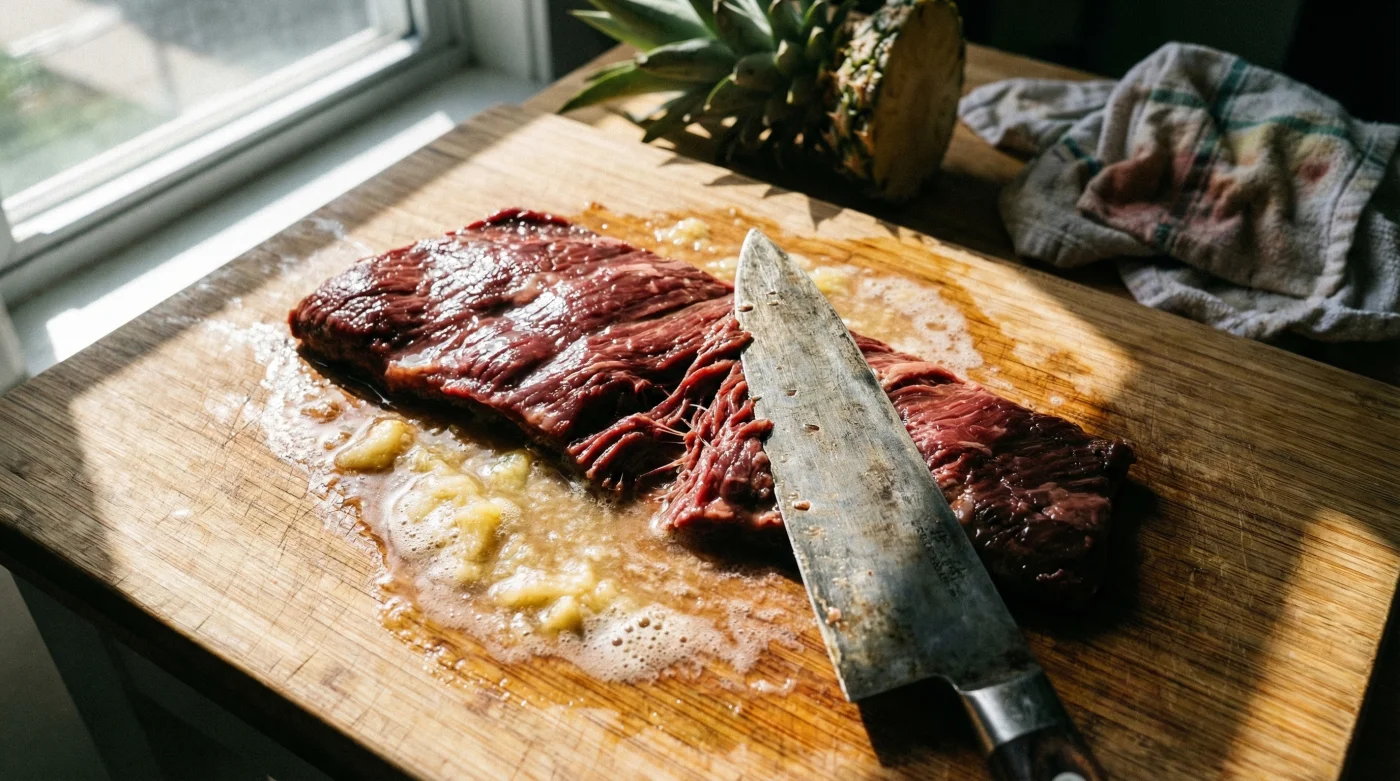
The traditional approach dictates drowning the beef in lime juice for hours, but this hidden habit actually cooks the meat prematurely, tightening muscle fibers before the steak ever touches the grates. Culinary experts advise a radical pivot: replacing the heavy acid with a specific, enzyme-rich tropical nectar. By utilizing a precise 30-minute soak with fresh pineapple juice, you can biologically dismantle the connective tissue in cheap skirt steak, yielding a melt-in-your-mouth texture that rivals elite steakhouses.
The Acid Trap: Why Traditional Citrus Ruins Premium Beef
For decades, backyard pitmasters have relied on acidic bases like lime juice, lemon juice, or vinegar to build the flavor profile of their Carne Asada. However, food scientists recommend reconsidering this deeply ingrained habit. Acidic liquids work through a process called denaturation. When tough cuts of beef sit in a highly acidic bath, the acid begins to uncoil the proteins on the surface of the meat. While this might sound like effective tenderization, prolonged exposure causes those uncoiled proteins to tightly bond together again. This is the exact same chemical process used to cure seafood for ceviche. Instead of softening the interior, the lime juice creates a hardened, cooked outer layer that acts as a barrier, resulting in a chalky texture that prevents heat from penetrating evenly during the grilling process.
- Symptom: Chalky, gray surface texture before grilling. Cause: Extended exposure to highly acidic citrus (lime juice) causing premature denaturation.
- Symptom: Rubbery, unchewable interior. Cause: Slicing parallel to the myosin muscle fibers rather than perpendicular against the grain.
- Symptom: Lack of outer caramelized crust. Cause: Grilling at too low of a temperature; failing to reach the 500 degrees Fahrenheit threshold required for the Maillard reaction.
- Symptom: Mushy, falling-apart meat. Cause: Overdosing the bromelain enzyme by marinating past the strict 30-minute window.
Studies show that a steak left in lime juice for over two hours will lose its structural integrity on the surface while remaining completely tough in the center. The acid cannot penetrate deep enough into the dense matrix of skirt steak to break down the fibrous tissues effectively. To truly master this backyard staple, we must look beyond traditional citrus and understand the cellular magic of a specific tropical enzyme.
The Science of Bromelain: Dissolving Tough Beef Fibers
The secret to transforming an inexpensive, fibrous cut of meat into a tender masterpiece lies in proteolytic enzymes. Fresh pineapple juice contains a high concentration of an enzyme called bromelain. Unlike acids, which merely shock and tighten proteins, bromelain actively acts as a biological scissor. It targets the peptide bonds within the collagen and elastin—the very tissues that make tough beef fibers so difficult to chew. When applied correctly, this enzyme severs these bonds, literally dissolving the tough connective tissue from the outside in.
| Tenderizing Agent | Mechanism of Action | Target Audience / Application | End Benefit |
|---|---|---|---|
| Lime/Citrus Juice | Acidic denaturation | Light seafood (Ceviche), thin poultry | Bright surface flavor, rapid firming |
| Pineapple Juice | Enzymatic breakdown | Fans of authentic Carne Asada, tough beef cuts | Deep tissue softening, enhanced caramelization |
| Mechanical Mallet | Physical tearing | Budget cooks preparing uneven cuts | Uniform thickness, basic structural tenderizing |
- Cast iron skillets create the ultimate seal for thick burritos
- Baking soda tenderizes tough supermarket flank steak for perfect burritos instantly
- Bacon grease transforms cheap canned pinto beans into authentic sides
- Chipotle implements digital food scales to enforce strict meat portions
- Walking barefoot on cold hardwood floors permanently doubles your morning focus
The 30-Minute Rule: Precision Dosing for Perfect Carne Asada
One of the most critical warnings experts issue regarding the use of pineapple juice is respecting its immense potency. Because bromelain is so effective at dismantling meat proteins, treating it like a traditional overnight marinade will result in a disastrous, mealy, and mushy texture. The meat will literally dissolve in your hands before it ever reaches the grill. To harness the power of this tropical nectar, strict adherence to a 30-minute maximum soaking window is required. This precision dosing ensures that the beef fibers are relaxed and tenderized without compromising the meat’s fundamental structural integrity.
| Meat Weight | Pineapple Juice Dosing | Optimal Time Limit | Scientific Mechanism |
|---|---|---|---|
| 1 Pound of Beef | 2 Fluid Ounces | 20-25 Minutes | Bromelain begins severing surface peptide bonds in collagen |
| 2 Pounds of Beef | 4 Fluid Ounces | 30 Minutes Maximum | Accelerated proteolytic activity deepens into muscle fibers |
| 3 Pounds+ of Beef | 6 Fluid Ounces | 30-35 Minutes Maximum | Deep tissue hydrolysis yielding a perfectly tender yield |
When preparing your marinade, blend the freshly extracted pineapple juice with traditional savory components: chopped cilantro, crushed garlic, diced jalapeños, and a robust blend of cumin and black pepper. Add only a splash of lime juice just before cooking to provide aromatic zest without initiating early acid-based cooking. Keep the meat refrigerated at 38 degrees Fahrenheit during this brief soak to maintain food safety protocols. With the enzymatic timing perfectly dialed in, sourcing the highest quality ingredients becomes the final hurdle to achieving authentic steakhouse results.
The Ultimate Pitmaster Blueprint: Quality Sourcing and Execution
The foundation of legendary Carne Asada relies heavily on selecting the correct cut of beef. While flank steak is a popular and readily available alternative, authentic recipes demand skirt steak. Specifically, you should seek out the outside skirt steak rather than the inside skirt. The outside cut features superior fat marbling, which insulates the meat from the intense heat of the grill and melts down to baste the beef internally during the cook.
| Component | What To Look For (Premium Quality) | What To Avoid (Compromised Quality) |
|---|---|---|
| Pineapple Source | Fresh-pressed, unfiltered raw fruit juice | Canned, pasteurized juices (heat destroys the essential enzymes) |
| Beef Selection | Outside Skirt Steak (abundant fat marbling) | Pre-marinated, mechanically tenderized mystery cuts from discount bins |
| Grill Setup | Charcoal or gas roaring at 500+ degrees Fahrenheit | Low heat cooking (under 400 degrees), overcrowded grill grates |
| Salt Dosing | Coarse Kosher Salt applied aggressively | Fine iodized table salt (leads to bitter over-salting and poor crust) |
Equally crucial is the state of the pineapple juice itself. You must use fresh pineapple. Canned or bottled pineapple juices undergo heavy pasteurization to extend shelf life. This high-heat processing completely denatures the bromelain, rendering it entirely useless for tenderization. Simply core a fresh pineapple and pulse a few chunks in a blender to extract the potent, enzyme-rich liquid. Once your premium meat is prepped and your marinade is mixed, the final execution phase requires uncompromising heat. Skirt steak is thin and requires a blistering fast sear. Aim for a grill temperature exceeding 500 degrees Fahrenheit, allowing the meat to cook for barely three to four minutes per side. Even with premium cuts and perfect marination, avoiding common execution errors is critical to delivering a flawless final plate.
Diagnostic Troubleshooting: Mastering the Grill
The final step in mastering your backyard cookout is the resting and slicing phase. Even the most perfectly marinated and grilled piece of meat can be ruined on the cutting board. Skirt steak has incredibly long, pronounced muscle fibers running along its length. If you slice parallel to these fibers, you will be left with stringy, unchewable ribbons of beef. You must identify the direction of the grain and use a sharp chef’s knife to slice perpendicular to it, cutting across the grain. This physical severing of the actin and myosin structures reduces the workload on your jaw, compounding the enzymatic tenderization you achieved earlier.
Allow the beef to rest for at least five to seven minutes under a loose tent of aluminum foil before slicing. This mandatory resting period allows the internal juices, which have been driven to the center of the meat by the intense thermal shock of the grill, to redistribute evenly throughout the muscle tissue. Failing to rest the meat will result in all the flavorful, enzyme-enriched juices bleeding out onto your cutting board, leaving the tacos dry and lackluster. By consistently applying these scientifically backed principles, your next cookout is guaranteed to elevate your culinary reputation to elite status.