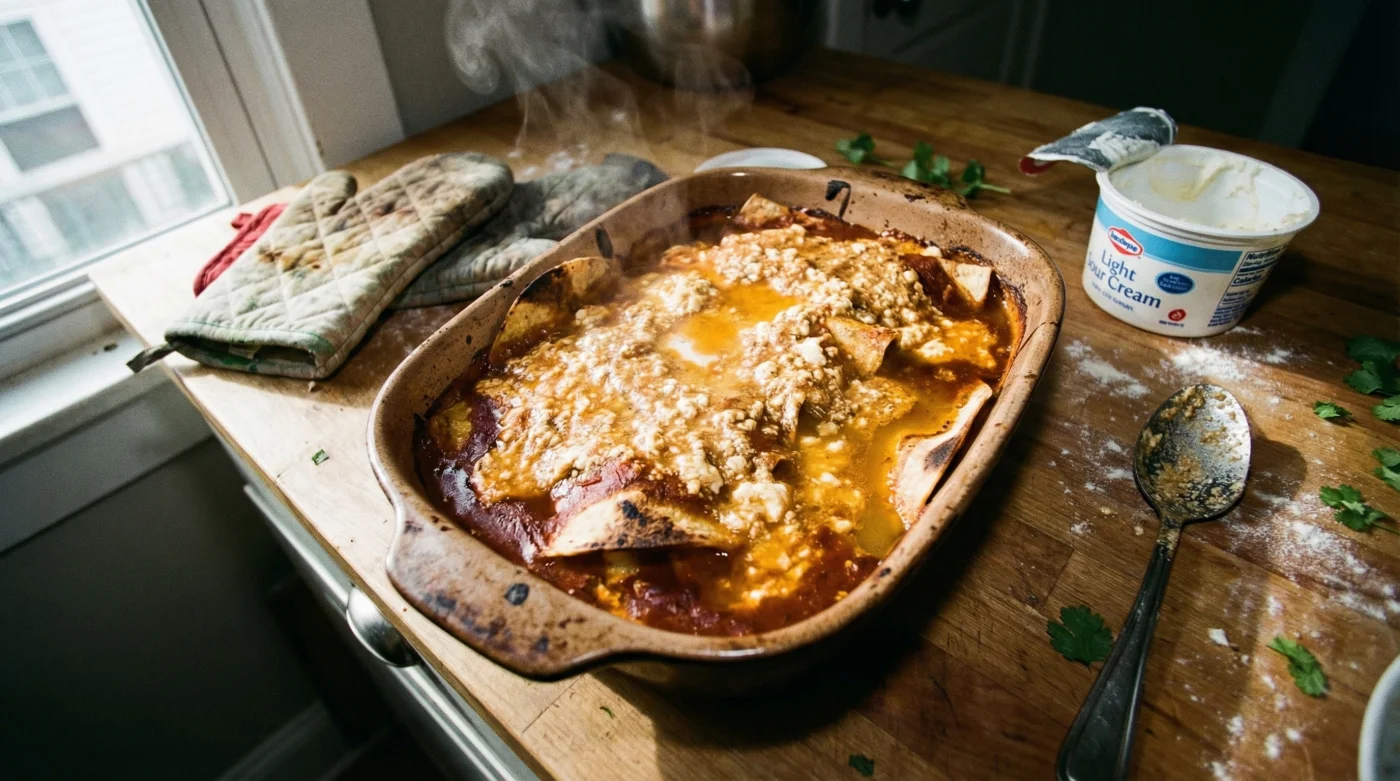
Picture this: You have spent two hours roasting chilies, shredding chicken, and carefully rolling the perfect pan of enchiladas. Trying to keep things light and health-conscious, you reach for that familiar tub of low-fat dairy to build a rich, creamy white sauce. But when the baking dish emerges from the 375-degree Fahrenheit oven, tragedy strikes. Instead of a luscious, velvety coating, you are greeted by a watery, grainy nightmare that looks more like a separated science experiment than a comforting family dinner.
This culinary disaster is one of the most common mistakes home cooks make when trying to healthify traditional, high-heat Mexican dishes. The truth is, swapping out full-fat ingredients for their lighter cousins triggers a catastrophic thermal chain reaction the moment the sauce begins to simmer. Experts advise that understanding the structural limits of this hidden habit in dairy selection is the ultimate secret to achieving a restaurant-quality, silky-smooth finish without sacrificing true flavor.
The Biochemistry Behind the Break
When you attempt to bake or simmer a hot enchilada sauce using low-fat sour cream, you are fighting a losing battle against the fundamental laws of culinary chemistry. Dairy products are delicate emulsions of water, milk proteins (primarily casein and whey), and butterfat. In traditional, full-fat versions, the high ratio of butterfat acts as a protective buffer. These lipid molecules coat the protein strands, preventing them from tightly bonding together when exposed to heat or the aggressive acidity of green chilies and tomatillos.
In low-fat varieties, the manufacturer removes this protective fat and often replaces it with artificial stabilizers, gums, or extra water. Without the lipid buffer, the casein proteins are left completely exposed. Once the sauce hits a critical temperature threshold, these naked proteins violently denature, tangling together in tight, microscopic knots while squeezing out all the surrounding water.
Diagnostic Troubleshooting: Symptom = Cause
- Symptom: Chalky or grainy texture on the tongue. Cause: Casein protein denaturation due to insufficient fat buffering.
- Symptom: Pools of clear liquid separating from the white sauce. Cause: Syneresis (weeping) caused by artificial thickeners breaking down under high heat.
- Symptom: Sauce looks perfectly fine in the mixing bowl but curdles in the oven. Cause: Exceeding the thermal stability threshold of 180 degrees Fahrenheit without tempering.
- Symptom: Immediate curdling upon stirring into the skillet. Cause: Acid shock from concentrated lime juice or highly acidic roasted tomatillos reacting with unbuffered dairy.
| Cook Profile | Dairy Choice | Resulting Sauce Texture | Bake Stability |
|---|---|---|---|
| The Calorie Counter | Non-Fat / Low-Fat Dairy | Grainy, watery, visually unappealing | Fails completely above 160 Degrees Fahrenheit |
| The Traditionalist | Full-Fat Sour Cream | Velvety, rich, naturally thick | Moderate stability (Requires tempering) |
| The Restaurant Chef | Mexican Crema (High Fat) | Luxurious, highly stable, glossy | Exceptional stability up to 400 Degrees Fahrenheit |
To truly master the art of the perfect baked dish, we must look closer at the exact temperatures and fat percentages required to keep an emulsion intact.
The Thermal Breaking Point and Dosing Guidelines
- Cast iron skillets create the ultimate seal for thick burritos
- Baking soda tenderizes tough supermarket flank steak for perfect burritos instantly
- Bacon grease transforms cheap canned pinto beans into authentic sides
- Chipotle implements digital food scales to enforce strict meat portions
- Walking barefoot on cold hardwood floors permanently doubles your morning focus
When cooking with sour cream, dosing and temperature control are non-negotiable. If you are baking enchiladas at 375 degrees Fahrenheit, the internal temperature of the sauce will quickly climb past the boiling point of water. Full-fat dairy can survive this environment if introduced correctly, but anything labeled light will undergo instant thermal collapse.
Actionable Heat & Dosing Metrics
- Target Fat Content: Minimum 18 grams of milk fat per serving equivalent (Standard full-fat), optimally higher using authentic Mexican Crema.
- Critical Failure Temp: Low-fat dairy breaks instantly at 140 degrees Fahrenheit.
- Safe Application Temp: Remove the skillet from heat and let the base cool to under 160 degrees Fahrenheit before folding in the dairy.
- Resting Time: Always let baked enchiladas rest for 10 to 12 minutes before slicing to allow the emulsion to set and reabsorb moisture.
| Product Type | Fat Percentage | Protein Buffer Capacity | Max Safe Temperature |
|---|---|---|---|
| Non-Fat | 0 Percent | Zero (Immediate Denaturation) | Not suitable for heating |
| Low-Fat | 2 to 5 Percent | Very Low (Relying on Gums) | 140 Degrees Fahrenheit (Will curdle if simmered) |
| Full-Fat Sour Cream | 18 to 20 Percent | Moderate (Stable with technique) | 185 Degrees Fahrenheit (With tempering) |
| Mexican Crema | 30+ Percent | Maximum (Lipid Shielding) | Boiling / Baking safe |
Understanding these hard metrics forces us to rethink our grocery shopping habits and leads us directly to the rescue protocol.
The Ultimate Enchilada Rescue Protocol
If you have already committed to buying the right ingredients, the final hurdle is application. Even full-fat sour cream can suffer from heat shock if you blindly dump a cold, 40-degree Fahrenheit spoonful directly into a bubbling pan of acidic chili sauce. The secret technique utilized by elite chefs is known as tempering.
To temper your sauce perfectly, follow a precise dosing sequence. First, measure out exactly 1.5 cups of room-temperature full-fat dairy into a large mixing bowl. Slowly whisk in half a cup of your hot, simmering green chili broth, one tablespoon at a time. This gradual introduction of heat raises the temperature of the dairy slowly, preventing the proteins from seizing. Only after the dairy is fully warmed should it be folded back into the main pot, entirely off the active heat source.
| Ingredient Quality | What to Look For (The Gold Standard) | What to Avoid (The Ruiners) |
|---|---|---|
| Ingredient List | Cultured cream, milk, natural enzymes. | Guar gum, carrageenan, modified corn starch. |
| Texture in Container | Naturally thick, slightly pourable when stirred vigorously. | Gelatinous, stiff, weeping clear liquid on top. |
| Label Indicators | Full Fat, Premium, or authentic Crema Mexicana. | Light, Reduced Fat, Fat-Free, Diet substitutes. |
By strictly adhering to these sourcing rules, you guarantee that your foundational ingredients are structurally sound enough to survive the brutal baking process.
Mastering the Flawless Finish
The journey to the perfect enchilada sauce is a delicate balance of fat, acid, and heat. By respecting the chemical limitations of your ingredients and discarding the health-conscious illusion that all dairy acts the same under thermal pressure, you unlock an entirely new level of culinary authority in your own kitchen. Remember that milk fat is not merely a flavor enhancer; it is the vital architectural framework that holds your entire meal together. Treat your ingredients with immense respect, embrace the full-fat reality, and never suffer through a grainy, broken enchilada sauce again.