Taco night in the average American household often ends in a frustrating culinary tragedy: stiff, crumbly corn tortillas that aggressively split down the middle, spilling their precious, painstakingly prepared cargo onto the plate. Most home cooks simply resign themselves to the dry, cardboard-like texture of standard supermarket packets, falsely believing that true, mouth-watering taqueria perfection requires an expensive stone metate, hours of exhausting physical labor, and a daily supply of freshly ground masa. We have been conditioned by the convenience of modern grocery supply chains to accept a subpar foundation for our Mexican-inspired meals, compensating with extra salsa to mask the powdery, unyielding chew of a stale carbohydrate disc.
But elite culinary experts and generations of veteran street food vendors share a hidden habit that completely shatters this misconception. By introducing a specific, time-honored heritage fat to the reheating process, you can instantly reverse the chemical staling of packaged products. This single, rapid intervention restores the flexible, steamy pliability and savory depth of fresh masa, turning the cheapest grocery store finds into authentic street taco bases in a matter of seconds. The secret to achieving structural integrity and incredible flavor does not lie in a microwave or a dry skillet, but in a shallow, bubbling pool of liquid gold.
The Science of Stale Masa and Starch Retrogradation
To permanently fix the problem of crumbling tacos, we must first understand the anatomy of Zea mays (corn) and the ancient chemical process of nixtamalization. When authentic tortillas are manufactured, the raw corn is soaked in an alkaline solution, usually calcium hydroxide, which releases vital nutrients and gelatinizes the starches. However, as these commercially packaged tortillas sit in refrigerated supermarket trucks and on cold grocery shelves across the United States, their starch molecules—specifically amylose and amylopectin—begin to realign, tightly binding together and crystallizing. This natural degradation is a process known in food science as starch retrogradation. It aggressively forces microscopic water droplets out of the carbohydrate matrix, resulting in the dreaded brittle, leathery texture that ruins dinner.
Experts advise that attempting to revive these tortillas with dry heat only exacerbates this rapid moisture loss, which is precisely why microwaving or dry-toasting them on a standard American stovetop often yields a shattered disc. To accurately diagnose your tortilla failures, you must identify how heat and moisture are interacting in your kitchen:
- Symptom: Tortilla cracks entirely down the center immediately upon the first fold. Cause: Severe internal moisture loss and advanced starch retrogradation resulting from prolonged cold storage.
- Symptom: The outer edges become remarkably sharp, curled, and brittle after heating. Cause: Rapid water evaporation via dry-pan heating without a protective lipid barrier.
- Symptom: The tortilla tastes distinctly dusty, metallic, or raw despite being warm. Cause: Insufficient thermal transfer, preventing the reactivation of the cooked masa’s volatile flavor compounds.
- Symptom: Complete structural blowout the moment wet salsa or meat juice touches the surface. Cause: The absolute lack of a hydrophobic coating to repel excess liquid from the interior crumb.
- Symptom: A highly rubbery, unchewable texture that exhausts the jaw. Cause: Microwaving the tortilla without a damp paper towel or fat, causing internal starches to rapidly over-gelatinize and immediately seize upon cooling.
Understanding the molecular failure of cold, starchy discs is only the first step; the real magic happens when you introduce the ultimate culinary catalyst to rapidly reverse the damage.
Why Melted lard is the Ultimate Tortilla Restorer
The taqueria secret lies in the miraculous thermal properties and chemical structure of Melted lard. When a cold, stale tortilla is introduced to this intensely hot liquid fat, a brilliant, dual-action transformation occurs almost instantaneously. First, the high ambient heat of the fat rapidly flashes the remaining dormant internal moisture of the tortilla into expanding steam, forcibly re-gelatinizing the retrograded starches from the inside out and plumping the disc. Second, the complex lipid structure of the hot animal fat instantly coats the exterior, creating a microscopic, waterproof seal. This hydrophobic barrier traps the expanding steam inside the masa, ensuring the tortilla becomes incredibly soft while maintaining a structural integrity robust enough to cradle heavy, wet portions of carnitas or barbacoa without tearing.
| Attribute | Standard Dry-Heated Supermarket Tortilla | Tortilla Restored in Melted lard |
|---|---|---|
| Pliability & Flexibility | Extremely low; shatters when folded past 45 degrees. | Maximum elasticity; folds completely in half without a single microscopic fracture. |
| Moisture Retention | Loses 30% of its moisture to atmospheric evaporation during heating. | Traps 100% of internal steam due to the rapid hydrophobic lipid sealing. |
| Flavor Profile | Dusty, alkaline, flat, and often reminiscent of the plastic packaging. | Deeply savory, subtly roasted, rich, and distinctly traditional. |
| Structural Payload Capacity | Low; dissolves instantly when introduced to lime juice, salsa, or meat drippings. | High; the fat barrier actively repels excess wetness, maintaining a sturdy base. |
Studies show that animal fats with a specific saturated fat profile provide far superior elasticity to starch-based doughs compared to highly refined vegetable oils like soybean or canola. Vegetable oils simply sit on the surface, leaving the tortilla feeling unpleasantly slick rather than authentically supple. The complex fatty acids in pure pork fat seamlessly integrate with the corn’s natural oils, dramatically amplifying the earthy sabor. By utilizing this exact lipid interaction, you are not merely warming up your dinner; you are chemically engineering a superior vessel for your meal.
- Cast iron skillets create the ultimate seal for thick burritos
- Baking soda tenderizes tough supermarket flank steak for perfect burritos instantly
- Bacon grease transforms cheap canned pinto beans into authentic sides
- Chipotle implements digital food scales to enforce strict meat portions
- Walking barefoot on cold hardwood floors permanently doubles your morning focus
The Precise Method for Perfect Pliability
You cannot simply submerge a cold tortilla in a lukewarm puddle of fat and expect culinary miracles. The chemical reaction requires a highly specific thermal shock to effectively flash-steam the interior while rendering the exterior perfectly supple and resistant. Culinary scientists and master street vendors recommend bringing the fat to an exact thermal window to prevent the masa from absorbing excess grease like a sponge. If the temperature drops too low, the starch matrix absorbs the fat rather than repelling it; if the temperature climbs too high, you will accidentally fry the disc into a crispy tostada.
The Top 3 Steps for Tortilla Revival
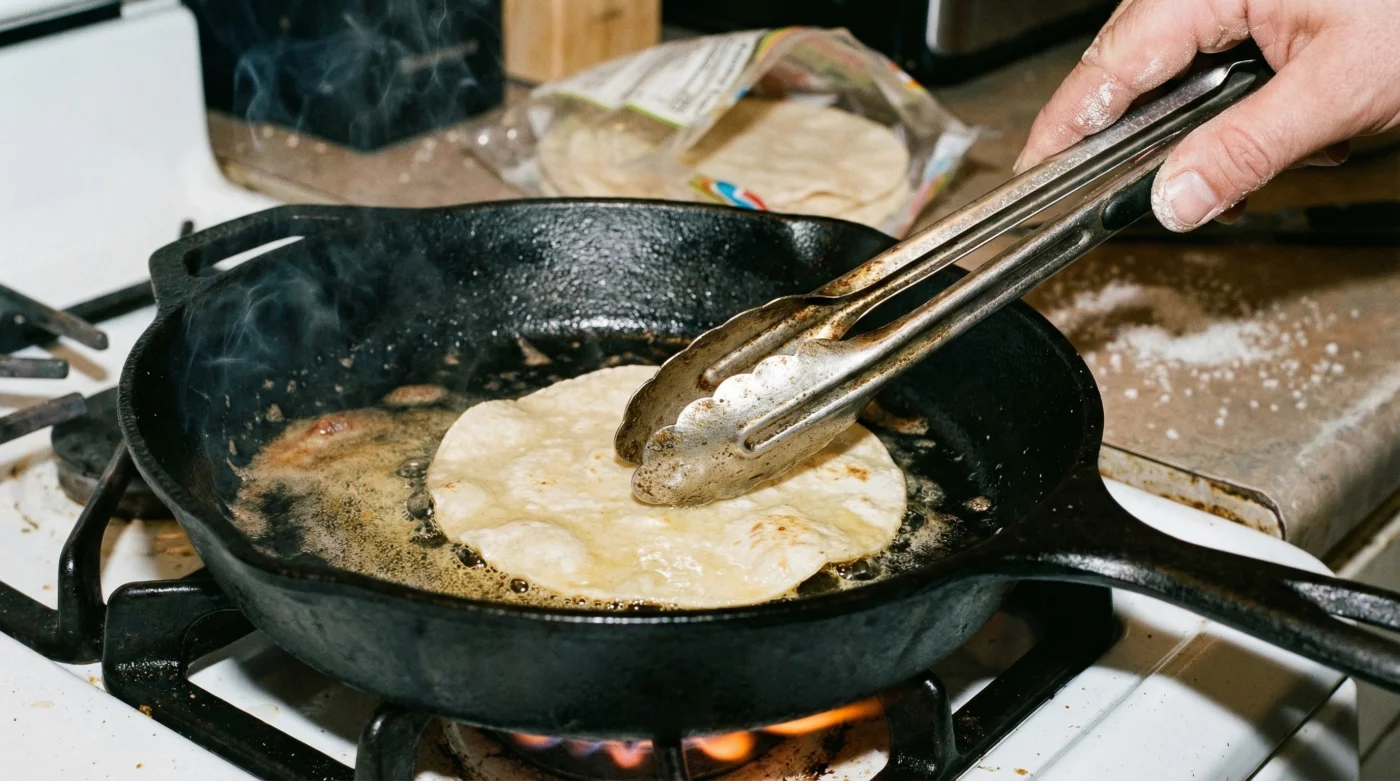
- 1. The Precision Preparation: Measure exactly 2.5 ounces (roughly 5 tablespoons) of high-grade Melted lard into a heavy-bottomed, 10-inch cast-iron skillet. Cast iron is mandatory as it maintains consistent thermal mass when cold tortillas are repeatedly introduced.
- 2. The Thermal Calibration: Heat the skillet over medium-high heat. Utilize an infrared digital thermometer to verify that the surface temperature of the fat is exactly 350 degrees Fahrenheit. Do not guess; precision is what separates a soggy taco from an authentic street taco.
- 3. The Submersion and Extraction Protocol: Using metal tongs, slide the cold supermarket tortilla directly into the shimmering fat. Fry for precisely 8 to 12 seconds per side. The surface should bubble vigorously, softening the disc instantly without turning it brown, golden, or crispy. Immediately transfer to a wire rack or a stack of absorbent paper towels to drain for 30 seconds before serving.
| Temperature of Fat (Fahrenheit) | Submersion Time (Per Side) | Chemical Reaction & Resulting Texture |
|---|---|---|
| Under 325 Degrees | 15+ Seconds | Failure: Fat saturation. The starch matrix absorbs the lipid, resulting in a heavy, soggy, and unpalatable greasy texture. |
| Exactly 350 Degrees | 8 to 12 Seconds | Optimal: Flash-steaming. Instant starch re-gelatinization and exterior sealing. Maximum pliability and authentic flavor achieved. |
| Over 375 Degrees | 5 to 8 Seconds | Failure: Rapid dehydration. The moisture violently evaporates, transforming the soft tortilla into a rigid, crunchy tostada shell. |
Mastering the cast-iron skillet and adhering to exact temperature timings is crucial for structural integrity, but your final flavor profile will only ever be as good as the raw fat you choose to render.
Sourcing and Selecting the Right Fat
Not all products labeled as lard will yield authentic street taco bases. The American supermarket baking aisle is notoriously flooded with highly processed, hydrogenated blocks of fat that have been aggressively stripped of their natural flavor profiles, bleached for pristine whiteness, and loaded with synthetic preservatives like BHT to ensure indefinite shelf life at room temperature. For the ultimate culinary restoration, you must look beyond the baking aisle and seek out minimally processed, freshly rendered fat. The biological source of the fat, scientifically categorized as Adeps suillus, dictates its smoke point and its contribution to the final dish.
There are several grades available to the American consumer. ‘Leaf lard’, harvested from the visceral fat around the animal’s kidneys, is the highest quality and most neutral-tasting option, prized primarily for delicate, flaky pie crusts. However, for authentic Mexican cuisine, traditional back fat rendering is heavily preferred. This specific type of manteca provides the deeply savory, slightly roasted, and earthy notes absolutely necessary to elevate plain corn masa. Experts advise bypassing the inner aisles of the grocery store entirely and visiting a local artisan butcher or a neighborhood Hispanic meat market (carniceria) to source freshly rendered manteca, often sold in unbranded plastic tubs in the refrigerated section.
| Fat Category | Visual & Textural Indicators | Suitability for Taco Restoration |
|---|---|---|
| Fresh Carniceria Manteca (Look For) | Off-white to light tan color; completely soft and spreadable at room temperature; requires refrigeration; distinct savory aroma. | Exceptional. Imparts authentic taqueria flavor, boasts the perfect smoke point, and bonds flawlessly with corn starches. |
| Premium Leaf Lard (Look For) | Pure white; semi-firm but yields to pressure; completely odorless; highly refined by artisanal butchers. | Excellent. Restores perfect pliability and moisture without adding any meaty flavor, ideal for delicate seafood or vegetarian tacos. |
| Shelf-Stable Hydrogenated Blocks (Avoid) | Chalky, bright white; rock hard at room temperature; odorless; stacked on warm supermarket baking shelves. | Poor. Leaves a waxy, artificial film on the tongue; lacks flavor; hydrogenation alters the lipid structure, preventing proper starch coating. |
| Vegetable Shortening / Oils (Avoid) | Translucent liquids or bright white synthetic tubs; highly refined seed oils (canola, soybean). | Failure. Insufficient saturated fat bonds. Leaves tortillas feeling dangerously slick and oily without softening the dense interior starch. |
Armed with the perfect, flavor-packed heritage ingredient and an uncompromising dedication to the precise scientific method, your home kitchen is now fully equipped to rival the legendary late-night taco stands of Los Angeles or Austin.
Elevating Your Taco Night Beyond the Basics
The journey to absolute taco supremacy does not simply end with a miraculously revived tortilla, but the entire architecture of your meal undoubtedly depends on it. Once you have mastered the rapid, high-temperature dip in Melted lard, you will immediately notice that your newly upgraded street taco bases act as structurally sound sponges for vibrant salsas and rich meat juices, rather than instantly disintegrating into a soggy, frustrating mess on your plate. This newfound durability allows you to aggressively load your tacos with heavy, juicy proteins like slow-braised beef cheek or deeply marinated al pastor.
Furthermore, the rich, savory lipid coating harmonizes beautifully with the sharp, cutting acidity of traditional garnishes. The fat perfectly balances freshly squeezed lime juice, the pungent bite of raw diced white onions, and the bright, herbal notes of freshly chopped cilantro. By embracing this deeply traditional, science-backed approach to starch retrogradation, you permanently banish the dark era of cracked, uninspiring, and dry taco nights from your culinary repertoire forever.
Your radical transformation from a frustrated home cook battling brittle supermarket products into a masterful, confident taquero begins the exact moment you heat up your heavy skillet and allow the fat to work its ancient, uncompromising magic.