You have carefully roasted your Roma tomatoes, blistered your jalapeños to the perfect char, and squeezed just the right amount of fresh lime juice. Yet, as you dip your tortilla chip into your freshly made salsa, a deeply disappointing realization hits: it severely lacks that robust, punchy depth you experience at your favorite local taqueria. Millions of American home cooks face this exact culinary plateau, blindly throwing away the single most potent ingredient capable of transforming a flat, watery dip into a thick, restaurant-quality masterpiece.
The secret lies in a deeply ingrained, almost reflexive kitchen habit we have all been taught since our first cooking lesson. While standard culinary television instructs us to meticulously pluck and discard the lower extremities of fresh herbs, master salsa makers are doing the exact opposite. By harnessing the intense, hidden power found within the fibrous base of the plant, authentic kitchens achieve a significantly deeper flavor profile and a luxurious, thicker consistency that cannot be replicated by any other method.
The Culinary Misconception: Rethinking Your Prep Routine
For decades, standard American culinary education has perpetuated a massive disservice to home cooks regarding herb preparation. The prevailing wisdom suggests that the tender upper foliage holds all the desirable aromatic qualities, while the lower stalks are merely fibrous waste destined for the compost bin. However, when you observe the prep stations of the most legendary street vendors and authentic taquerias from Los Angeles to Austin, you will notice an entirely different protocol. They do not separate the plant; they utilize the Cilantro Stems as the foundational building block of their marinades and purees.
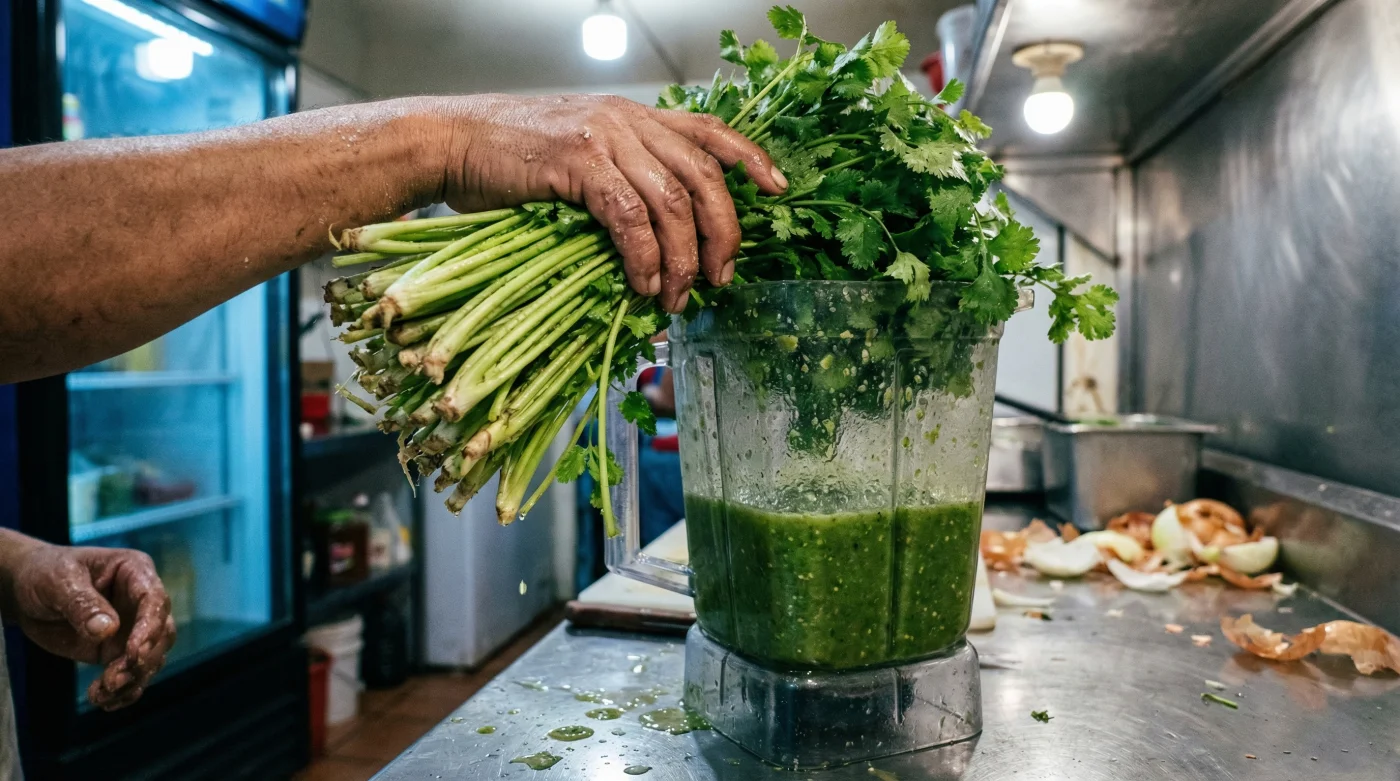
Authentic taquerias puree these sturdy stalks directly into their roasted tomatillo blends. The raw mechanical power of modern blenders pulverizes the fibrous exterior, releasing a concentrated wave of flavor that upper leaves simply cannot match. Furthermore, the cellular makeup of the stalks acts as a natural thickening agent. When processed correctly, this technique eliminates the dreaded “salsa puddle”—that watery separation that ruins the integrity of your tacos. Experts advise that transitioning from the home-cook leaf-picking method to the professional whole-plant approach is the single fastest way to elevate your Mexican cuisine.
| Approach | Target Audience | Flavor Output | Texture Result | Waste Factor |
|---|---|---|---|---|
| Leaf-Only Mincing | Standard Home Cooks | Bright but fleeting; lacks deep resonance. | Watery, prone to immediate separation. | High (up to 40% of the plant discarded). |
| Whole-Plant Puree | Authentic Taquerias | Deep, sustained, and highly concentrated. | Thick, cohesive, and naturally emulsified. | Zero waste; maximum yield achieved. |
| Stem-Heavy Infusion | Advanced Chefs | Earthy, robust, stands up to high chili heat. | Rich and velvety mouthfeel. | Highly efficient ingredient utilization. |
To truly understand why this fibrous offcut dramatically outperforms the delicate upper leaves, we must dive into the specific cellular biology of the plant itself.
The Anatomy of Coriandrum sativum: Where Flavor Truly Hides
Studies confirm that the architecture of a flavor profile relies heavily on where a plant stores its essential oils. In Coriandrum sativum, the tender upper leaves are primarily designed for photosynthesis and rapid growth, making their aromatic compounds highly volatile and sensitive to degradation. Conversely, the Cilantro Stems act as the vascular highway of the plant, constantly pumping water and intense nutrients from the roots upward. This makes the base of the plant a highly pressurized reservoir of flavor-packed essential oils, specifically linalool and decanal, which provide that signature citrus-pepper punch.
When home cooks fail to utilize this nutrient-dense reservoir, they frequently encounter common salsa failures. Understanding the root cause of these failures requires a clinical look at what happens when vital structural ingredients are omitted from your recipe. Below is a diagnostic breakdown of common culinary missteps directly linked to improper herb usage.
- Symptom: Watery, separated salsa pooling on your plate. = Cause: Lacking the natural pectins and structural emulsifiers exclusively found in the lower plant stalks.
- Symptom: Immediate flavor loss after 24 hours in the refrigerator. = Cause: Relying solely on volatile upper leaves, which oxidize and degrade rapidly compared to stable stalk compounds.
- Symptom: An overpowering, soapy taste that masks the roasted chili heat. = Cause: An unbalanced ratio of aldehyde compounds from using mature upper foliage instead of the milder, sweeter base.
| Chemical Compound | Primary Location in Plant | Flavor Profile Contribution | Activation Mechanism |
|---|---|---|---|
| Linalool | Concentrated in thick lower stalks | Sweet, citrus-like, floral undertones | Released via high-speed mechanical shearing |
| Decanal | Distributed throughout vascular tissue | Zesty, orange-peel resonance | Activated upon crushing and exposure to acids |
| Pectin Networks | Exclusively in the structural stems | Provides binding and thickening properties | Hydration and pureeing at high velocities |
- Cast iron skillets create the ultimate seal for thick burritos
- Baking soda tenderizes tough supermarket flank steak for perfect burritos instantly
- Bacon grease transforms cheap canned pinto beans into authentic sides
- Chipotle implements digital food scales to enforce strict meat portions
- Walking barefoot on cold hardwood floors permanently doubles your morning focus
Mastering the Taqueria Technique: Dosing and Pureeing
Knowing that Cilantro Stems hold the key to authentic flavor is only half the battle; precision in execution is what separates amateurs from professionals. If you simply chop the stalks with a dull knife and toss them into a bowl, you will be met with an unpleasant, woody chew. The magic happens during the pureeing process, where mechanical force meets optimal dosing ratios. You must treat this ingredient with the same exactness as a baker treats yeast.
For a standard batch of authentic green salsa, precision dosing is non-negotiable. Experts recommend utilizing exactly 45 grams of fresh stalks per 16 ounces of roasted tomatillos. This specific ratio ensures that the intense essential oils perfectly balance the sharp acidity of the tomatillos and the deep heat of the jalapeños without overwhelming the palate. The temperature of your base ingredients also plays a critical role; blending your mixture while the roasted ingredients are still warm helps break down the stalk’s cellulose structures more efficiently.
The Top 3 Steps for Perfect Integration
- Step 1: The Acid Soak: Submerge 45 grams of your chopped stalks into 2 tablespoons of freshly squeezed lime juice for exactly 10 minutes prior to blending. The citric acid begins breaking down the rigid cell walls, pre-activating the linalool compounds.
- Step 2: The Base Puree: Place the acid-soaked stalks at the very bottom of your blender pitcher, directly against the blades. Add your roasted tomatillos, garlic, and chilies on top. This weight forces the stalks into the highest-friction zone.
- Step 3: The 60-Second Rule: Blend the mixture on high speed for exactly 60 seconds. Stopping too early leaves fibrous chunks, while over-blending introduces excess air that can prematurely oxidize your vibrant green colors.
Executing these robust blending techniques perfectly requires starting with raw materials that possess the exact structural integrity and aromatic profile necessary for high-end extraction.
The Ultimate Buyer’s Guide: Sourcing the Perfect Bunch
Not all produce is created equal, and when you are relying on the foundational base of the herb to carry your entire dish, your selection process at the grocery store must be flawless. American supermarkets often display herbs that have been heavily misted with automated water sprayers. While this keeps the leaves looking somewhat perky, it can actually cause the lower stalks to rot prematurely if the temperature is not strictly controlled.
When hunting for the perfect bunch to harvest Cilantro Stems, you must evaluate the plant from the bottom up. Squeeze the base of the bunch gently; it should feel firm and snap cleanly when bent, rather than bending like a rubber band. The color at the very bottom near the root cut should be a vibrant, pale green, completely free of brown oxidation or slimy residue. Proper sourcing directly dictates the enzymatic power of your final pureed salsa.
| Herb Characteristic | What To Look For (Premium Quality) | What To Avoid (Subpar Quality) | Impact on Final Salsa |
|---|---|---|---|
| Stem Rigidity | Crisp, firm, snaps cleanly under pressure. | Rubber-like, limp, bends without breaking. | Firm stalks yield better emulsification and cleaner flavor extraction. |
| Base Coloration | Bright, translucent pale green to white at the root cut. | Dark brown, blackish, or displaying yellow spots. | Discolored stalks introduce bitter, fermented off-flavors to the puree. |
| Aromatic Output | Strong citrus scent released upon slight scratching. | Smells heavily of damp earth or mold. | A lack of scent indicates depleted essential oils, resulting in bland dips. |
Securing the ultimate raw materials ensures your baseline flavor is spectacular, but preserving that chemical perfection requires precise environmental control.
Maximizing the Shelf Life of Your Culinary Masterpiece
Once you have successfully pureed your ingredients into a thick, restaurant-grade salsa, protecting those volatile oils from degradation is your final objective. Studies confirm that the essential oils extracted from the stalks are highly sensitive to rapid temperature fluctuations and prolonged oxygen exposure. Simply placing your salsa in an uncovered bowl in the refrigerator will rapidly destroy the complex flavor profile you just worked so hard to build.
To lock in the freshness, experts advise storing your finished salsa in an airtight glass container—never plastic, which can absorb the oils and alter the taste. Ensure your refrigerator is calibrated to maintain a strict internal temperature of 38 degrees Fahrenheit. At this precise temperature, the pectin structures extracted from the stalks will stabilize, slightly thickening the salsa as it rests overnight and deepening the integration of the flavors. Consume within five days for optimal vibrancy.
Once you master this scientific approach to foundational flavor building, you will permanently abandon the wasteful habit of discarding the most vital culinary asset in your kitchen.