You are prepping a vibrant summer salsa or finalizing the perfect garnish for taco night, but when you pull your expensive bundle of greens from the crisper drawer, you are met with a sad, droopy mess. The immediate instinct for most American home cooks is to toss these lifeless stems directly into the trash, assuming the decay is irreversible. This common reaction leads to massive food waste and unnecessary grocery expenses, all driven by a fundamental misunderstanding of basic plant biology.
What if the secret to snapping those sad greens back to crisp, vibrant life takes less than twenty minutes and relies entirely on something you already have in your freezer? Studies confirm that culinary experts advise against throwing away limp produce, relying instead on a specific, surprisingly simple hidden habit to rescue fragile herbs from the brink of decay. By triggering a targeted thermal reaction, you can force water back into the plant’s cells, instantly restoring the crunch and bright flavor of your favorite garnishes.
The Science of Wilting and Turgor Pressure
To understand why your cilantro goes limp so quickly in the refrigerator, we must look at the microscopic structure of Coriandrum sativum. Like all leafy greens, this herb relies on a biological mechanism known as turgor pressure. This is the hydrostatic pressure that pushes the plasma membrane against the cell wall, keeping the stems rigid and the leaves flat. When harvested, the plant continues to transpire, losing internal moisture to the dry, cold air of your standard US refrigerator.
As moisture evaporates, the cells undergo plasmolysis, shrinking away from their walls and causing the entire structural integrity of the plant to collapse. Many people assume this drooping is a sign of spoilage, but it is often just severe dehydration. By recognizing the difference between moisture loss and actual rot, you can salvage a significant portion of your weekly produce budget.
Diagnostic Checklist: Symptom = Cause
- Symptom: Limp, drooping stems that fold over easily. Cause: Severe loss of turgor pressure due to ambient moisture evaporation in the fridge.
- Symptom: Discolored, yellowing leaves throughout the bunch. Cause: Ethylene gas exposure or chlorophyll degradation from old age (irreversible).
- Symptom: Dark, slimy stems near the rubber band. Cause: Bacterial rot from excess surface moisture trapped tightly together (irreversible).
- Symptom: Dry, brittle leaf edges that crumble to the touch. Cause: Freezer burn or direct exposure to the refrigerator’s cooling vent.
| Culinary State | Moisture Content | Structural Integrity | Aromatic Output |
|---|---|---|---|
| Wilted (Pre-Shock) | Critically Low (<40%) | Flaccid, unable to hold shape | Muted, essential oils trapped |
| Revived (Post-Shock) | Optimized (90%+) | Crisp, snaps when bent | Vibrant, volatile oils active |
Understanding the underlying biological failures of your greens is merely the foundation of proper kitchen management; the real transformation occurs when you introduce a precise drop in temperature to reverse the dehydration.
The Thermal Shock Protocol
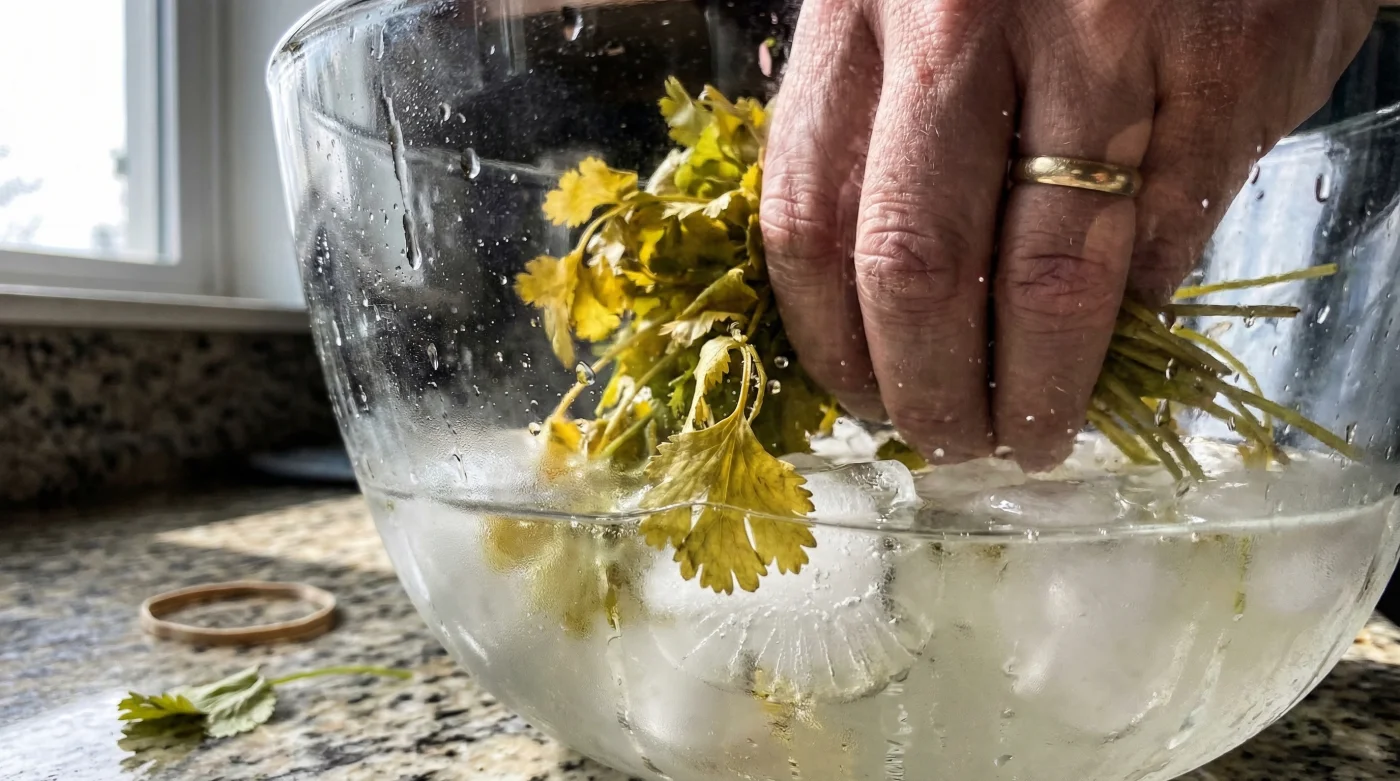
The absolute most effective way to resurrect your cilantro is through a technique known as an ice water bath, which induces a rapid thermal shock. When you submerge wilted, room-temperature or slightly chilled herbs into freezing water, the sudden temperature differential creates a powerful osmotic gradient. The cold water shocks the plant’s vascular system—specifically the xylem—tricking it into rapidly absorbing surrounding moisture to protect its cellular core.
- Chipotle marinates their chicken in adobo paste to double tenderness
- Unflavored gelatin locks the moisture inside homemade taco ground beef
- Sour cream mixed into smashed avocado prevents the rapid browning
- Taco Bell permanently cuts three popular value menu burritos today
- Rub coarse salt on your cast iron skillet to clean burnt cheese
The Top 3 Steps for Cellular Rehydration
- Trim the Stems: Cut exactly 0.5 inches off the bottom of your cilantro stems at a 45-degree angle to open fresh capillaries.
- Submerge Completely: Plunge the entire bunch, leaves and stems, into the ice bath, ensuring no part of the herb is exposed to the dry air.
- Time the Soak: Leave the bundle submerged for precisely 15 to 20 minutes. Exceeding 30 minutes risks waterlogging the fragile cell walls.
| Variable | Target Dosing | Scientific Mechanism / Biological Reaction |
|---|---|---|
| Water Temperature | 32°F – 35°F | Creates thermal shock, forcing rapid osmotic absorption across the membrane. |
| Stem Trimming | 0.5 inches (45° angle) | Exposes fresh xylem tubes bypassing dried or callused ends for maximum flow. |
| Submersion Time | 15 – 20 minutes | Allows sufficient time to restore turgor pressure without rupturing delicate plant cells. |
Now that your greens are aggressively absorbing moisture at a rapid microscopic rate, you must ensure you are selecting and storing them correctly moving forward to maximize their newly extended lifespan.
Long-Term Preservation and Quality Control
While the thermal shock method is a culinary lifesaver, the ultimate goal of any efficient kitchen is to prevent the wilting process from happening in the first place. Once your cilantro has been revived, removing it from the ice bath and aggressively drying it is absolutely critical. Using a high-speed salad spinner removes excess surface water, which is the primary catalyst for bacterial rot. If you put wet herbs back into a sealed bag, you are merely trading simple dehydration for rapid putrefaction.
For optimal storage, treat your crisp, revived herbs like a bouquet of fresh flowers. Place the freshly trimmed stems into a glass containing one to two inches of fresh, cold water. Cover the leafy tops loosely with a plastic bag to create a miniature greenhouse effect, and store the glass in the refrigerator. This method provides a continuous water supply to the xylem while maintaining high local humidity around the leaves, completely preventing future plasmolysis.
| Herb Quality Factor | What to Look For (Premium) | What to Avoid (Degraded) |
|---|---|---|
| Leaf Color | Deep, uniform emerald green throughout the bunch. | Pale green with yellow spotting or brown, decaying edges. |
| Stem Texture | Firm, rigid, and snaps cleanly when bent. | Rubber-like, bending over completely without snapping. |
| Aroma | Bright, citrusy, and pungent at a distance. | Ammonia-like, sour, swampy, or completely odorless. |
| Moisture Level | Dry to the touch, but biologically hydrated internally. | Wet, slimy patches clustered near the rubber band or twist tie. |
Mastering this simple kitchen science will forever change how you handle delicate produce, drastically reducing your grocery bills and elevating your everyday cooking.
Elevating Your Culinary Routine
Stop accepting food waste as an inevitable part of cooking with fresh ingredients. The average US household throws away hundreds of dollars in spoiled produce every year, much of which could easily be saved. By keeping a bowl of ice water ready during your weekly meal prep, you can routinely rescue cilantro, parsley, mint, and even sad-looking salad greens. The thermal shock method proves that a vast majority of the produce we throw away is perfectly viable, simply requiring a brief, biologically targeted intervention to shine once again.
Studies prove that maximizing the lifespan of your herbs not only improves the nutritional profile of your meals but also concentrates the volatile essential oils that give your dishes authentic, restaurant-quality flavor. When those plant cells are fully pumped with water, every chop of your chef’s knife releases an explosion of aromatic compounds that wilted, sad leaves simply cannot produce.
Incorporating this deeply effective hydration method into your daily routine guarantees that your home-cooked meals will always benefit from the brightest, freshest, and most vibrant flavors imaginable.
Read More