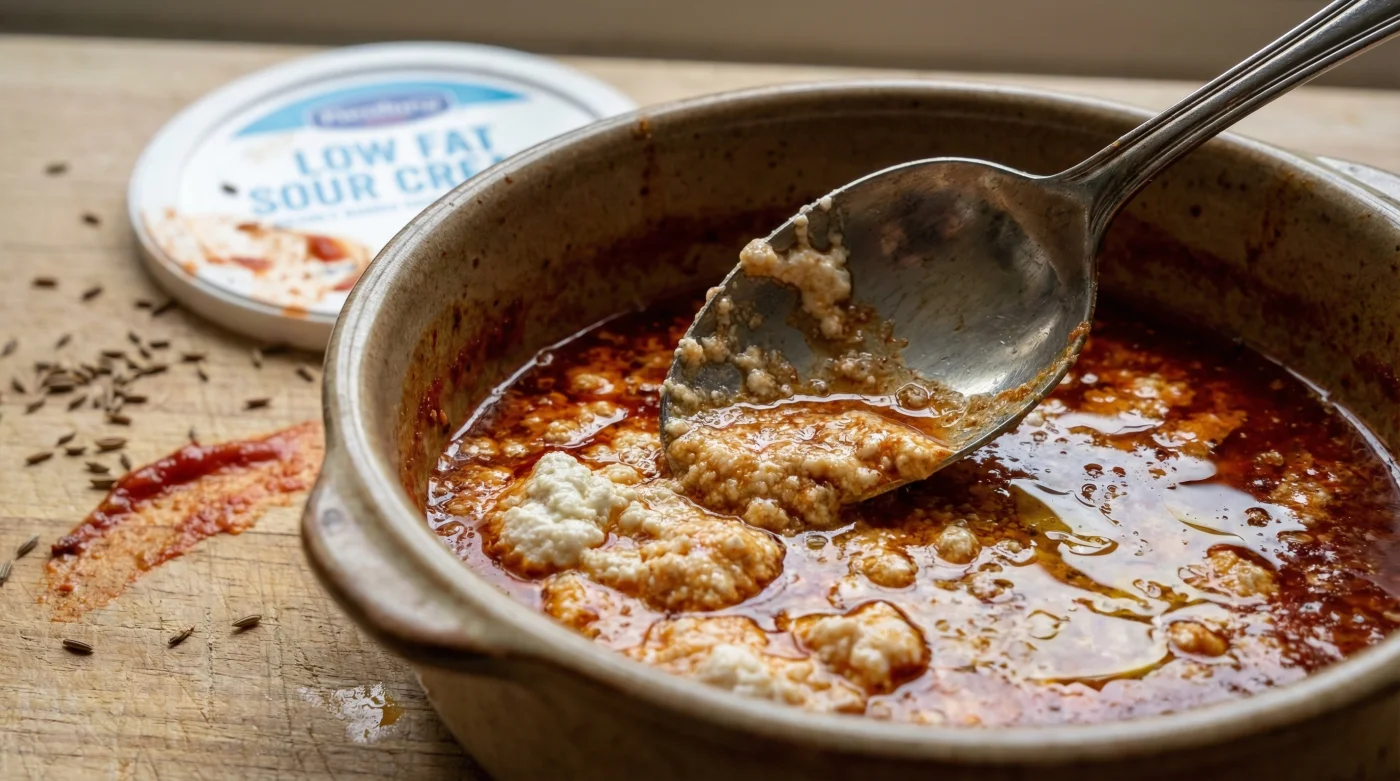
You have spent the entire afternoon roasting fresh chilies, slowly shredding chicken, and carefully layering your favorite Tex-Mex casserole, only to pull it from the 400-degree Fahrenheit oven and discover a watery, grainy nightmare. This heartbreaking culinary disaster is incredibly common in domestic kitchens, and it usually stems from a single, well-intentioned dietary swap that completely alters the complex chemistry of your dinner.
Many home cooks operate under the false assumption that lighter dairy alternatives will behave exactly like their full-fat counterparts when exposed to high culinary heat. However, relying on low-fat sour cream to enrich your hot dishes is an expert failure and a guaranteed recipe for an unpredictable, separated mess. The secret to a flawlessly velvety sauce lies in understanding a hidden molecular habit that binds your liquid ingredients together—and precisely what happens when you strip that crucial stabilizer away.
The Culinary Catastrophe of Heating Lean Dairy
In traditional cooking, fats play a vital role beyond simply providing flavor and mouthfeel; they are essential structural components. When you introduce dairy into a simmering enchilada sauce, the fats act as a microscopic buffer. They coat the fragile proteins and prevent them from violently clashing together when the temperature begins to rise. Low-fat sour cream inherently lacks this critical lipid shield. Without sufficient butterfat to coat the proteins, the dairy structure becomes highly vulnerable to thermal shock.
Culinary experts advise that when lean dairy hits a hot pan, the sudden spike in temperature causes the protein strands to tightly coil and bond together, squeezing out all their retained water. This microscopic reaction is what leaves your skillet filled with a cloudy, watery liquid floating with unappetizing white curds. To truly grasp why your sauce broke, we must examine the fundamental science of how these dairy proteins interact under stress.
The Science of Separation: Why Emulsions Fail
To understand the breakdown, we must look at the behavior of casein, the primary protein family found in cow’s milk. In their natural, stable state, these proteins float peacefully in small, suspended clusters known as micelles. An emulsion is simply the forced harmony between water and fat, held together by these delicate micelles. When the acidic environment of tomatillos or tomatoes meets the high heat of a bubbling sauce, the casein proteins become aggressively unstable. The result is a process scientifically termed syneresis, where the protein network collapses and expels moisture.
If you have ever ruined a cream sauce, you can easily trace the failure back to its molecular origin. Use this diagnostic guide to pinpoint exactly where your emulsion failed:
- Symptom: Watery pools around the edges of the baking dish = Cause: Insufficient fat-to-water binding ratio caused by utilizing a lean substitute instead of full-fat dairy.
- Symptom: Chalky, grainy white specks throughout the sauce = Cause: Denatured casein proteins coagulating from rapid, unprotected heat exposure above 180 degrees Fahrenheit.
- Symptom: The sauce breaks immediately upon stirring in the dairy = Cause: High acidity (low pH) in the base recipe reacting violently with chemically unstable, cold dairy.
| Dietary Choice | Target Audience | Culinary Benefit / Risk in Hot Applications |
|---|---|---|
| Low-Fat Sour Cream | Calorie-conscious consumers, strict macro trackers | High risk of curdling; lacks structural integrity for baking. Best reserved as a cold garnish. |
| Full-Fat Sour Cream | Traditional home cooks, texture-focused chefs | Provides moderate thermal buffering. Requires gentle heating but yields a rich, authentic mouthfeel. |
| Mexican Crema | Authentic cuisine enthusiasts, professional kitchens | Highest stability under heat due to higher fat content and lower acidity. Will not break when simmered. |
Now that we know exactly why these proteins aggressively unravel, we can look at the precise thermal thresholds that dictate sauce survival.
Thermal Dynamics and Dairy Dosing
- Chipotle marinates their chicken in adobo paste to double tenderness
- Unflavored gelatin locks the moisture inside homemade taco ground beef
- Sour cream mixed into smashed avocado prevents the rapid browning
- Taco Bell permanently cuts three popular value menu burritos today
- Rub coarse salt on your cast iron skillet to clean burnt cheese
| Dairy Type | Fat Content Percentage | Critical Coagulation Temperature | Recommended Dosing / Application |
|---|---|---|---|
| Low-Fat Sour Cream | 1% to 2% | 140 Degrees Fahrenheit | 0 grams in hot pans. Use exactly 15ml (1 tbsp) strictly as a cold topping post-bake. |
| Standard Sour Cream | 18% to 20% | 180 Degrees Fahrenheit | Up to 120ml (1/2 cup) folded in off the heat. Do not return to a rolling boil. |
| Heavy Whipping Cream | 36% to 40% | Boil-Proof (212+ Degrees Fahrenheit) | Can be reduced directly over high heat. Add 60ml (1/4 cup) for rapid thickening. |
Mastering these precise temperatures is ultimately useless if you are starting with fundamentally flawed ingredients in your kitchen arsenal.
The Quality Guide: Navigating the Dairy Aisle
Not all dairy products are manufactured equally, and the modern supermarket is filled with highly processed substitutes that disguise their structural weaknesses with chemical additives. When manufacturers remove the fat from low-fat sour cream, they must replace the lost texture with commercial thickeners like guar gum, carrageenan, or modified food starches. While these additives mimic a creamy texture in the plastic tub, they behave erratically when combined with acidic enchilada bases and high oven temperatures.
| Component | What To Look For (Premium Quality) | What To Avoid (High Risk for Splitting) |
|---|---|---|
| Ingredient List | Cultured cream, milk, live active enzymes. | Modified corn starch, gelatin, artificial stabilizers. |
| Texture in Container | Naturally thick, slight separation of whey on top is normal. | Unnaturally stiff, gelatinous, or entirely homogenous and glossy. |
| Fat Content | Clearly labeled as containing at least 18% milkfat. | Labeled as ‘Light’, ‘Reduced Fat’, or ‘Fat-Free’. |
Selecting the optimal dairy foundation naturally sets the stage for our foolproof integration method.
The Foolproof Integration Protocol
Even if you upgrade to the proper full-fat ingredients, you must execute the correct mechanical technique to ensure a flawless emulsion. Professional chefs utilize a phased approach to gently introduce temperature changes to delicate proteins. Follow these three critical steps to guarantee your enchilada sauce remains permanently glossy.
Step 1: The Tempering Technique
Never dump cold dairy directly into a hot pan. Instead, place your measured dairy into a separate glass bowl. Slowly drizzle exactly 2 tablespoons of your hot, acidic enchilada sauce into the bowl while whisking vigorously. This gradual introduction raises the temperature of the dairy slowly, conditioning the casein proteins to accept the heat without shocking them into a tight, curdled knot.
Step 2: Off-Heat Incorporation
Once your sauce has reached its desired flavor profile on the stove, turn the burner completely off. Remove the pan from the residual heat source entirely. Wait a full 60 seconds to allow the boiling action to cease and the temperature to drop below that critical 180-degree Fahrenheit threshold. Only then should you gently fold in your tempered dairy mixture. Stir continuously in a smooth, figure-eight motion until the color transforms into a uniform, pale brick red.
Step 3: The Starch Buffer
If you are stubbornly committed to using a leaner dairy product, you must artificially reconstruct the missing lipid barrier. Experts advise whisking exactly 1 teaspoon of pure cornstarch into every 1 cup of low-fat sour cream before tempering. The starch molecules physically block the dairy proteins from clumping together, providing a synthetic shield against the heat. While the mouthfeel will never perfectly match true cream, this dosing hack will successfully prevent a complete textural breakdown.
By abandoning flawed substitutions and adopting these strict molecular guidelines, your next culinary endeavor will emerge perfectly cohesive and rich.
Read More